
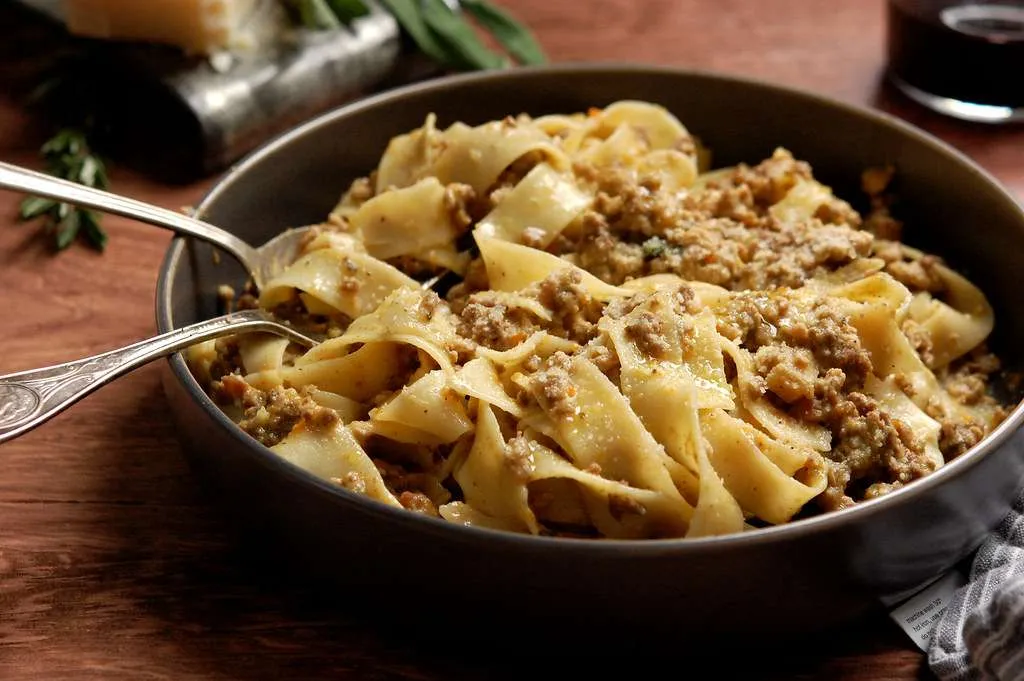
You say tomato, we say leave it out. This traditional ragù bianco recipe, or white Bolognese sauce is everything you love about a slow-cooked meat ragù, but without tomato. It’s rich, silky, meaty, and deeply savory, and clings perfectly to pasta. This recipe was developed from first-hand experience eating ragù bianco in Bologna, Italy, and is worth every minute of cook time.
Jump To:
All About This Authentic White Ragù, or Ragù Bianco, Recipe
You likely already know pasta Bolognese. This is its less famous, but equally wonderful sibling: ragù bianco. Literally translated as “white ragù,” this slow-cooked meat sauce uses no tomato, but is built on a soffritto (minced carrot, onion, celery), pancetta (some kind of cured pork is always in a true Bolognese ragù), dry white wine, woody herbs, and whole milk, simmered low and slow until the meat is tender and the sauce is thick, glossy, and deeply savory.
I first encountered ragù bianco at the source: Bologna, Italy. Wandering through the ancient brick streets, piazzas, and red roof-lined boulevards of Italy’s food capital, I think the only reason I paused sightseeing was to eat — you guessed it — ragù at the small trattorias and osterias the city is famous for. (Side note: Bologna is considered the most important food city in Italy, even nicknamed “La Grassa,” or “the fat one.” The Emilia-Romagna region actually has whole museums dedicated to prosciutto and Parmigiano-Reggiano cheese.)
Far from your average Italian-American meat sauce (which is basically tomato sauce with bits of crumbled ground beef swimming in it), a true ragù is thick, rich, crumbly, but never dry.
Of all the ragùs variations I tried in Bologna, the ragù bianco impressed me the most. It did not look fancy, but wow. Here was a sauce layered with savory umami from browning the meat rendered soft and silky from broth and milk and time, with gentle aromatics from rosemary and sage and nutmeg, with the melted vegetables adding just that special, sweet “something.” This white Bolognese is the real thing. Here’s how to make it.
Why This Recipe Works
Coco Chanel once said, “Before you go out, look in the mirror and take one thing off.” When it comes to making an authentic white pasta Bolognese, we, like Coco, are taking one thing out: the tomato. My personal dining experiences in Bologna, plus research into real Italian recipes and lots of testing in my kitchen, evolved into this perfected white ragù recipe, which I’ve been making for Sunday dinners and special occasions ever since.
This ragù bianco recipe works because it is:
- The real deal. This is a truly authentic recipe, developed from the ragù bianco in Bologna, the home of Bolognese sauce, which I tasted in Bologna and throughout the Emilia-Romagna region of Italy
- Uses good ingredients and a slow-cooking and browning technique. Good white wine, different herbs, nutmeg, millk, and a combination of meats like beef and prosciutto, and a silky soffritto that melts into the sauce all work together to layer flavor. Browning the meat builds deep flavor and texture slowly and effectively.
- A slow-cooking and browning technique. Time builds the flavor and melds the meat and other ingredients into a soft, silky sauce. This is a slow, multistep process, but don’t worry; none of it is complicated. A long time is key for making a true ragù.
- It’s make-ahead friendly. Ragù be made in advance — in fact, it’s even better the next day. It can also be frozen for up to 3 months.
Both red and white ragùs have the same essential building blocks. A soffritto (finely-diced or minced carrot, celery, onion) is cooked in a pan, followed by ground meat blend that’s browned over high heat, triggering the Maillard reaction. From there, you’ll deglaze the pan with white wine and add whole milk in stages. After two hours of simmering, the meat breaks down into a thick, perfect ragù fragrant with meat, herbs, and nutmeg.
A white Bolognese sauce skips tomato entirely, and only uses white wine. The more common Bolognese ragù incorporates tomato paste or crushed tomato into the sauce, plus red or white wine. (And then there’s Lady Gaga, who uses rosé. But she can do whatever she wants; she’s Lady Gaga.)
If you love the results of a long, patient braise, the red wine braised short ribs on this site use the same low-and-slow technique: different protein, same deeply satisfying payoff.
What Goes Into This Recipe
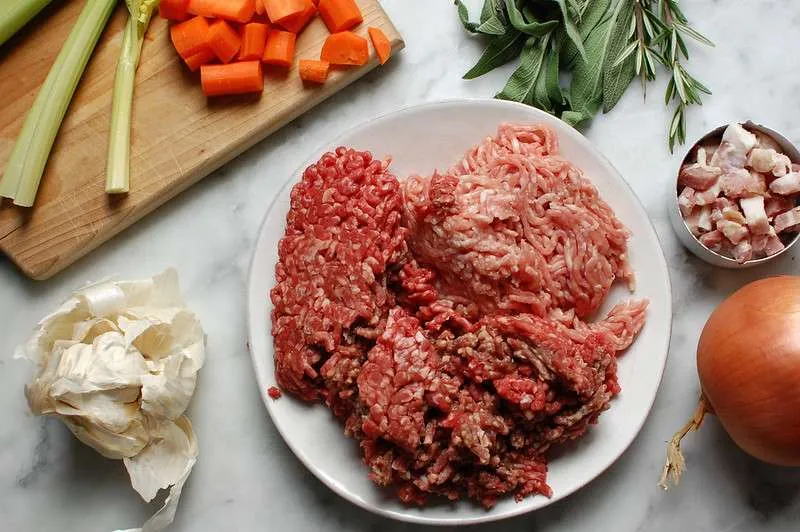
In addition to the basics (olive oil, salt and pepper), here’s what goes into this recipe:
- Pancetta: Italian bacon (technically cured pork belly), but without the American-style smokiness. All true ragù uses ham in addition to the ground meat.
- Beef, pork, and veal blend: Also known as “meatloaf mix,” these ground meats are the star of the show. If you don’t want to use veal or pork, substitute more beef, but avoid using all beef; the result will be denser and one-dimensional.
- Soffritto: a blend of finely-minced carrot, celery, onion that adds body and a bit of sweetness
- Aromatics and herbs: Garlic, sage, rosemary, and nutmeg add aroma and depth to the sauce
- Liquids: White wine, chicken stock, and whole milk deglaze the pan and build the sauce’s flavor and silky texture
- Pasta: Wide, flat noodles like tagliatelle or pappardelle are the best choices here. You could also do a substantial, tubular pasta like rigatoni, but even something like fusilli would be great.
- Parmigiano-Reggiano: Don’t skimp on the Parmesan. Use the real deal; true Parm-Regg comes from the same region as white Bolognese, and the taste is no comparison to the other stuff.
Love cooking with great Italian cheese? The Gorgonzola pasta on this site is another Northern Italian classic worth knowing; it’s rich, quick, and deeply satisfying. If you love a tomato-based pasta sauce with a touch of cream, you should definitely get this pasta with vodka sauce recipe.
Substitutions and Variations
Substituting the Veal: Use 1 pound ground beef and 1/2 pound ground pork. Slightly richer, a bit less delicate, but still great. If you’re thinking of substituting ground chicken or turkey for a portion of the meat blend, just avoid lean, all-white meat; your ragù will be dry and bland.
No pancetta? Thick-cut, uncured bacon is the closest substitute. Guanciale (cured pork jowl) is the more traditional, Italian substitution.
Pancetta pulls double duty in another Italian pasta favorite on this site — pasta with pancetta and peas, adapted from Marcella Hazan, comes together in 20 minutes and uses it just as well.
Extra meats: Some authentic Bolognese recipes incorporate a small amount of finely minced prosciutto or mortadella into the meat mixture. This is a nod to Emilia-Romagna traditions, where the surrounding region’s extraordinarily varied cured pork heritage has a way of finding its way into ragù. If you can get your hands on either, add one to two ounces, finely minced, along with the ground meat.
A splash of cream at the finish: There is enough whole milk in this recipe to reduce down into a glossy, rich sauce. But some regional variations stir in a small glug of heavy cream in the final minutes, which adds extra gloss and richness.
Why You Should Put Milk in Your Ragù Bianco (White Bolognese Sauce)
Like virtually all other Italian ragù recipes, this white ragù recipe adds whole milk. Milk adds a depth of flavor, and contributes to a silky texture of the finished pasta. Some recipes call for cream at the end instead of milk, but the concept is the same.
How to Make Ragù Bianco, Step by Step
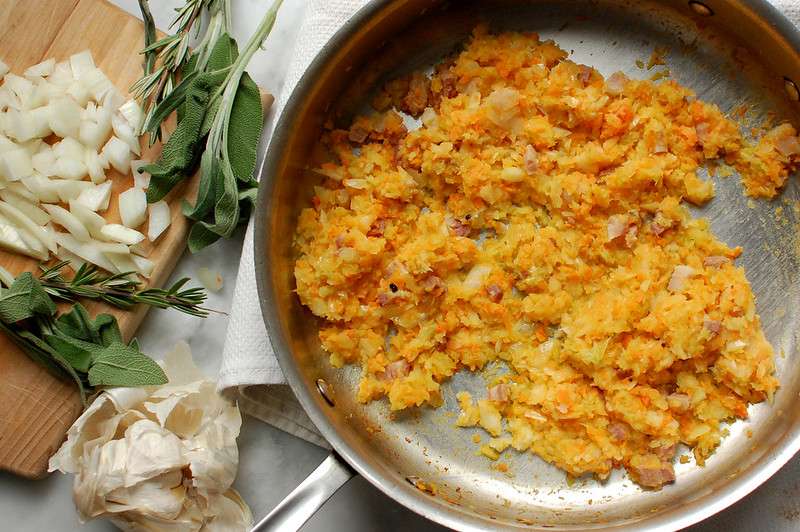
Step 1: Make the soffritto. Pulse the onion, carrot, and celery in a food processor until very finely minced. The smaller the pieces, the more completely they’ll dissolve into the sauce.
Step 2: Cook the pancetta and soffritto. Cook the pancetta in olive oil until the fat renders and the edges begin to turn golden. Add the soffritto and cook, stirring occasionally, until everything is completely softened. Don’t rush it; you are building important flavor. Set aside.
Step 3: Brown the meat. Cook the ground meat and make sure you get deep browning: the color, crust, and aroma are from the Maillard reaction doing its job. This step is where a significant portion of the sauce’s flavor is built. Gray meat is a missed flavor opportunity. Brown the meat in batches if needed to avoid crowding the pan.
Step 4: Deglaze with wine. Stir in the white wine and scrape up everything stuck to the bottom of the pan. Those browned bits are concentrated flavor, and the wine pulls them back into the sauce where they belong.
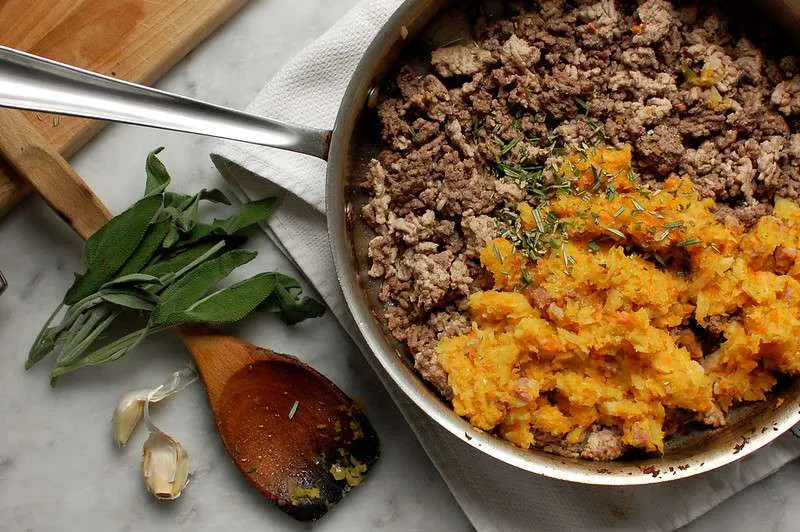
Step 5: Bring it all together and simmer. Add the soffritto back to the pan, along with the garlic, sage, rosemary, nutmeg, salt, pepper, and the first round of chicken stock and milk. Stir to combine, partially cover, and settle in. This sauce now needs approximately two hours of gentle, patient simmering, stirring occasionally, adding stock and milk in stages as the liquid reduces.
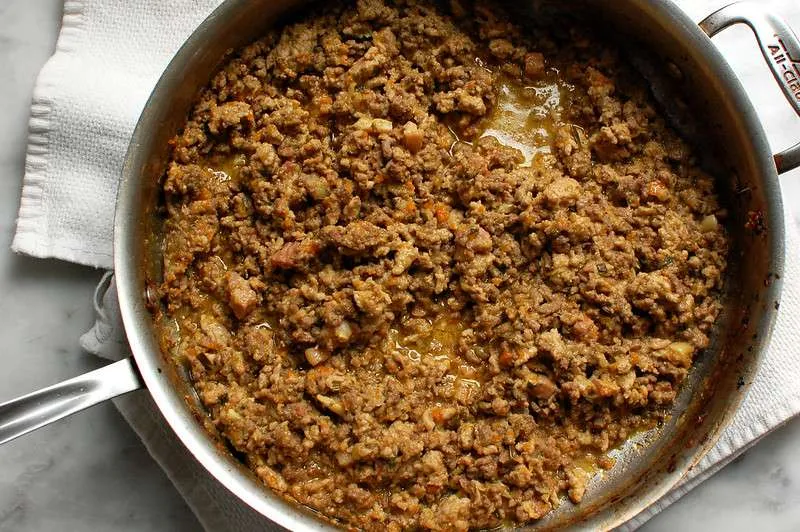
The sauce is ready when it’s thick and glossy: cohesive, barely fluid, with a visible sheen. That gloss is your visual cue that the fat has fully emulsified and the liquid has reduced properly. Watery means more time or more heat. Dry and crumbly means a small splash of stock.
Step 6: Cook the pasta and finish. When the ragù has been simmering for a little over an hour, cook the pasta just shy of al dente, and reserve some pasta water before draining. Stir the final addition of milk into the ragù and season.

Remove about a third of the ragù from the pan and set it aside for serving. Add the pasta directly to the remaining sauce with a splash of pasta water, and toss until the pasta finishes cooking in the sauce and everything comes together in a glossy, unified whole.
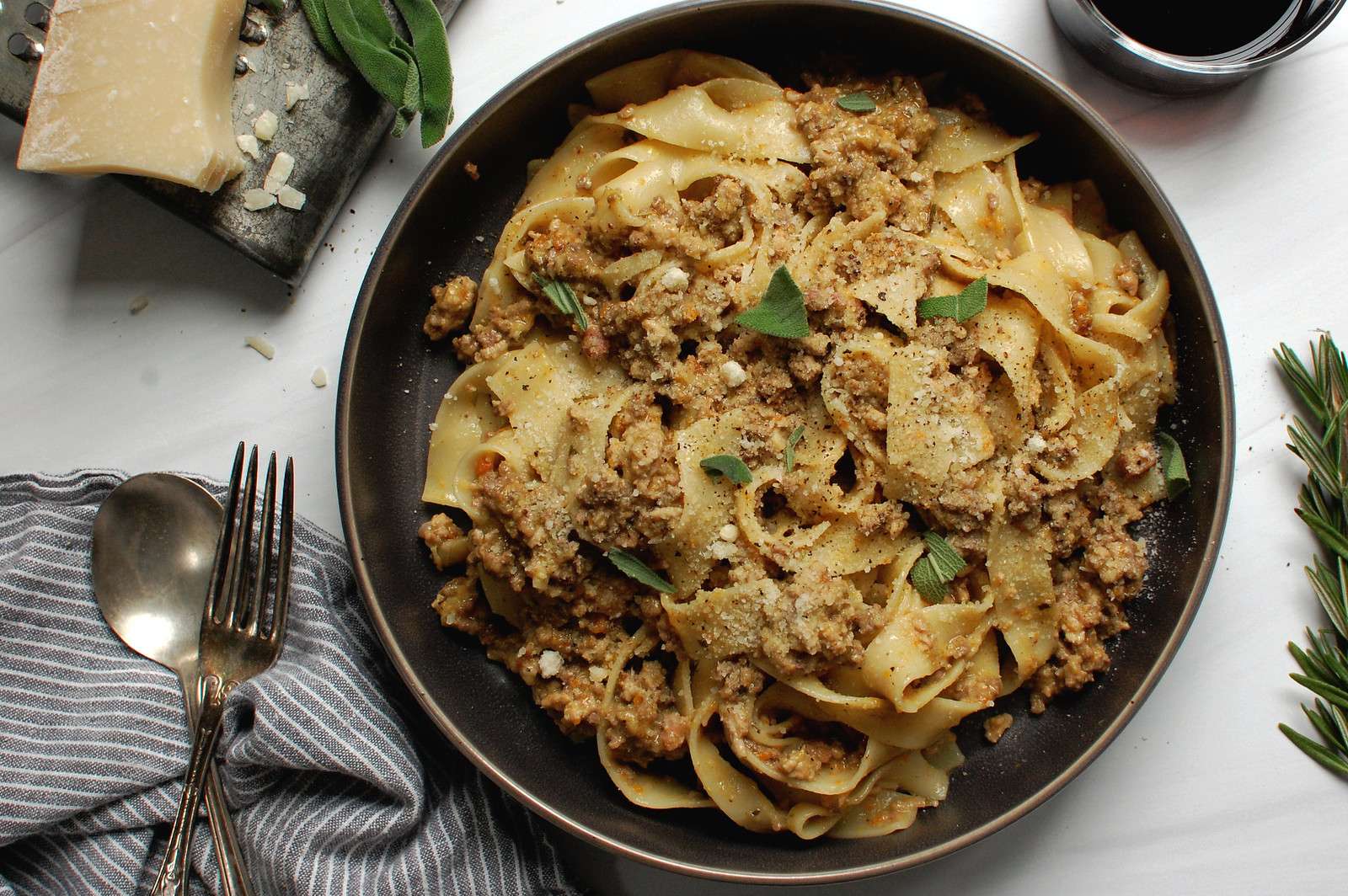
Step 7: Serve. Divide into bowls, spoon the reserved ragù over each portion, and finish with a very generous grating of Parmigiano-Reggiano and a few turns of black pepper. Serve immediately.
Which Pasta Shape Is Best for Ragù Bianco?
It is a truth universally acknowledged that certain sauces require certain pasta shapes. In Bologna, ragù is served on fresh egg pasta, usually tagliatelle. These wide, flat ribbons of pasta catch and hold the white Bolognese sauce beautifully, and the egg-enriched dough really holds up against the richness of the ragù. That said, this sauce works well with several shapes:
- Pappardelle: the widest ribbon pasta; exceptional with any substantial meat ragù
- Tagliatelle: the most traditional choice; use fresh if you can. (Tagliatelle also stars in this creamy smoked salmon pasta recipe.)
- Rigatoni: the ridged tubes trap sauce inside
- Fusilli: the corkscrew holds the crumbly meat in its spirals
Avoid small shapes like ditalini, orzo, or orecchiette. The crumbly meat sauce gets lost amid similarly small pasta. Avoid anything thinner than tagliatelle, like spaghetti; this is considered very wrong for a true Bolognese. Whatever shape you choose, cook to al dente only, and finish it in the pan with the sauce and some reserved pasta water as needed.
What Wine to Pair With Ragù Bianco?
For a white ragù recipe, I prefer a dry white wine. There is white wine in the recipe, so choose well and serve the rest at the table, nicely chilled but not refrigerator cold. Some best white wine options for your white Bolognese sauce include:
- Pinot Grigio/Pinot Gris
- Soave
- Sauvignon Blanc
- Chenin Blanc
- Viognier
My preference, in keeping with the spirit of the Italian meal, is to go with the Pinot Grigio or Soave. Both can be paired with the Bolognese for dinner. The acidity will balance the richness of the sauce.
Red wines should be on the medium-body, medium-tannin side with bright acid. Something like a Chianti Classico would be my top choice. I also like a Sangiovese, and a chilled Lambrusco would be a regional Emilia-Romagna choice popular with locals.
Bonus: Traveling to Bologna? Here’s Where to Find Top Pasta al Ragù and More
Bologna takes its food seriously — more seriously than almost anywhere else in Italy, which is saying something. The city has been called La Grassa (the fat one) for centuries, and it has earned the title. If you’re planning a visit, these are the places worth building your itinerary around.
Trattoria di Via Serra is beloved by locals, respected by serious food travelers and Michelin insiders alike. They do it right. Be sure to book ahead.
All’Osteria Bottega is, for many Bologna lovers, the single best restaurant in the city for traditional Emilia-Romagna cuisine. Located on a quiet street just outside the center, the tagliatelle al ragù and tortellini in brodo are the reasons to come, but the whole menu is a reason to stay. Reservations are essential; book well in advance.
Trattoria da Me has fed Bologna since 1937. One of the most respected and long-running trattorias in the city, it’s where to go for traditional Bolognese in a warm setting.
While You’re There: Eat Beyond the Ragù. Bologna’s other great dish is tortellini in brodo: tiny, delicate pasta parcels in a clear, deep broth, usually filled with meat. And before you leave the region, get the prosciutto. Parma is a short train ride away, and the cured pork of Emilia-Romagna (prosciutto, mortadella, culatello) is as much a part of the food culture as the ragù itself.
And be sure to check out Unpeeled Journal’s additional travel dining guides.
For another satisfying, traditional Italian pasta that’s restaurant-quality good, get the recipe for Pasta With Gorgonzola Sauce.
F.A.Q.s and Expert Tips
- Use a wide, heavy-bottomed skillet. A wide surface area is necessary for browning the meat properly. A cramped pan steams; a wide pan sears. A Dutch oven is ideal for the long simmer if you have one.
- The food processor is perfect for making the soffritto. Finely minced vegetables dissolve into the sauce over two hours. Coarsely chopped ones don’t. The texture difference in the finished dish is real and noticeable. If you don’t have a food processor, use a wide grater.
- Add liquids gradually. The stages of stock and milk is intentional. Each addition should be nearly absorbed before the next goes in. This is how the sauce builds its texture.
- Taste at the very end. The recipe calls for 1 1/2 teaspoons of kosher salt, but I almost always finish with another half teaspoon. Long simmers need a final seasoning check. Taste before you serve.
- Reserve pasta water. A full cup, minimum. Starchy pasta water is one of the most powerful tools in pasta cooking. It’s the difference between a sauce that coats and one that’s dry.
In Bologna, the answer is always tagliatelle or pappardelle. The wide ribbons provide the perfect surface area for the meat to cling to. For smaller options, rigatoni and fusilli are excellent. Avoid tiny pastas.
Yes. You can make this up to two days in advance. In fact, it will taste even better the next day as the flavors continue to meld. White Bolognese also freezes well for up to two months; thaw in the refrigerator overnight.
It likely over-reduced. Proper ragù bianco should be cohesive and glossy. Add broth or pasta water to bring it back, or loosen it in professional parlance.
Yes to both. For a Dutch oven: Once the wine has evaporated, transfer to a Dutch oven and braise covered at 325 degrees F for 2 to 2.5 hours, stirring every 45 minutes. For a slow cooker: Cook on low for 6 to 8 hours, uncovering for the last hour to let any excess liquid reduce. The stovetop method gives you the most control and is what I do, but all three get you to the same great place.
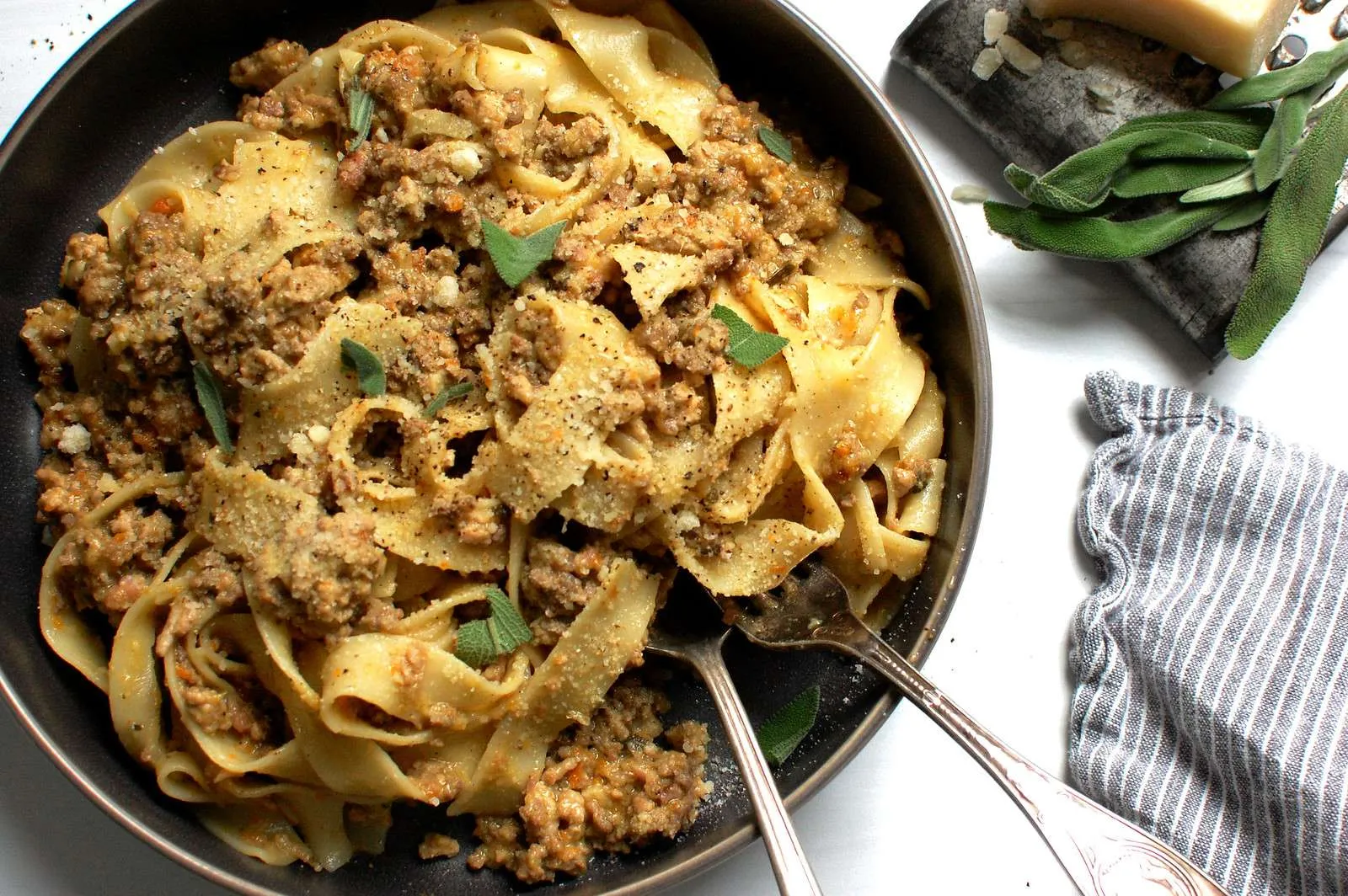
If you make this ragù bianco, I want to hear how it went. Leave a comment below — tell me which pasta shape you used, whether you made it ahead, and what you thought. A star rating makes a real difference for an independent site like mine. And for more Italian-inspired dinners worth dedicating a Sunday to:
- Easy, Creamy Gorgonzola Pasta: another Italian classic that tastes like a restaurant dish and takes about 20 minutes.
- Marcella’s Pasta With Pancetta and Peas: from the woman who taught America to cook Italian. Simple, perfect, twenty minutes.
- Pasta alla Vodka Sauce: if ragù bianco is your Sunday dinner, this is your Tuesday night.
- Red Wine Braised Short Ribs: same low-and-slow Sunday energy, but with short ribs. Deeply satisfying.
Ragù Bianco (White Bolognese Sauce) Pasta
Essential Equipment
- food processor the easy way to make the soffritto; otherwise, a box grater works great, too
- Large heavy skillet to make the white Bolognese sauce
- Large pot and colander for the pasta
Ingredients
For the Ragù
- 1 medium yellow onion, rough chopped
- 1 stalk celery, rough chopped
- 1 carrot, peeled and rough chopped
- 2 tablespoons extra-virgin olive oil
- 2 ounces pancetta, diced
- 1 1/2 pounds ground beef/pork/veal blend (if you prefer no veal, use 1 lb. ground beef and 1/2 lb. ground pork) also commonly known as "meatloaf mix"
- 1/2 cup white wine
- 2 cloves garlic, peeled and smashed
- 2 tablespoons finely-chopped fresh sage
- 2 tablespoons finely-chopped fresh rosemary
- 1/4 teaspoon fresh-ground nutmeg
- 1 1/2 teaspoons kosher salt (I use Diamond Crystal)
- 2 dozen turns fresh-cracked black pepper
- 1 1/2 cups unsalted chicken stock (added in stages)
- 1 cup whole milk (added in stages)
To Finish and Serve
- 1 pound dried pasta, such as pappardelle, tagliatelle, or rigatoni (fusilli could also work)
- Grated Parmigiano-Reggiano cheese
Instructions
- Make the soffritto. Place the chopped onion, celery, and carrot in a food processor and pulse until finely chopped. This is your soffritto.PRO TIP: If you don't want to use the food processor, you can leave the vegetables whole and grate using the large grates of a box grater, or finely dice everything by hand.
- Cook the pancetta and soffritto. Heat a wide-bottomed skillet over medium-low heat. Add the olive oil and pancetta and cook, stirring occasionally, until the fat renders, about 5 minutes. Add the soffritto. Increase the heat to medium and cook, stirring, until the vegetables are softened and the onions are translucent, about 5 minutes more. Spoon the soffritto and pancetta into a bowl and set aside.
- Brown the meat. Increase the heat to medium-high. Add the ground beef mix to the skillet and cook, breaking up the meat as much as you can, until browned. Do not stir too often so the meat can brown and develop good color and flavor.PRO TIP: This browning triggers the Maillard reaction, which creates the deep savory flavor of finished sauce.
- Deglaze with wine. Stir in the white wine, scraping up all the bits of meat. When the white wine has evaporated, lower the heat back to medium low.
- Build and begin the simmer. Add the soffritto, garlic, sage, rosemary, nutmeg, 1 teaspoon of kosher salt, and the pepper. Add 1 cup of chicken stock and about 1/3 cup milk. Give it a good stir, and partially cover the nascent ragù. You're on your way.
- First simmer: 30 minutes. Simmer, partially covered, for about 30 minutes, stirring once or twice. If it starts to look dry, dose it with some of the remaining chicken stock.
- Second simmer: 30 to 40 minutes more. Stir in an additional 1/3 cup milk and any remaining chicken stock. Simmer for an additional 30 or 40 minutes, partially covered, adding a little more liquid as necessary to keep things looking creamy, thick, and glossy — neither too dry and crumbly, nor soupy. That gloss is your visual cue that the fat has emulsified properly and the sauce is ready.
- Cook the pasta. After the ragù has cooked for an hour or slightly more, it's time to start the pasta. Heat a large pot of well-salted water and cook the pasta until a couple minutes shy of al dente. Drain, reserving some pasta water.
- Finish the ragù. While the pasta cooks, add the final 1/3 cup milk to the ragù. Give it a final stir and taste for seasoning. I tend to add an additional 1/2 teaspoon kosher salt.
- Combine pasta and sauce. Remove about 1/3 of the ragù bianco from the skillet and set aside. Add the drained pasta to the remaining ragù along with 1/2 cup (more or less) reserved pasta water. Stir or toss the pasta with the white ragù for a minute or two until the entire thing marries together in perfect harmony and the pasta is perfectly cooked, adding a little pasta water as needed.
- Serve. Divide the pasta into bowls. Spoon a bit of the remaining white Bolognese on top of each bowl of pasta. Garnish generously with grated cheese and maybe a twist of pepper or two. Serve immediately.
Notes
- Don’t want to use veal? Use 1 pound ground beef and ½ pound ground pork.
- Pancetta: Thick-cut bacon works, though the flavor will be smokier so aim for uncured. Guanciale is an even more traditional option if available. For another traditional Emilia-Romagna preparation, add 1 to 2 ounces of minced prosciutto or mortadella to the meat mixture.
Nutrition
Disclaimer: Nutrition information is provided for courtesy purposes only, and is an estimate not verified by medical or nutrition experts. Read the full nutrition disclaimer.
Why You Can Trust This Recipe: These recipes were developed and tested from scratch by Lisa Ruland, a Culinary Institute of America graduate(class valedictorian), Level 2 WSET-Certified Wine Professional(With Honors), and professional pastry chef and food writer/recipe developer who has worked for some of NYC’s top bakeries, and written for national food publications, including Bon Appétit, Saveur, Food52,and more. Lisa has traveled and dined in Bologna, Italy, and has tasted authentic ragù bianco in the city where it was born. Lisa is committed to providing accurate, trustworthy culinary guidance based on years of hands-on experience in professional and home kitchens. Learn more about Lisa’s background and expertise.




50 comments
Natacha
Really really good in its final form, however slightly annoyed that the ingredients list states that the vegetables be “roughly chopped” only to clarify they should be finely chopped within the actual recipe. Had to break out the food processor after cutting everything by hand:(
Lisa Ruland
Hi, Natacha! Thanks so much for this comment. I completely see your point. The “rough chop” was meant as a precursor for putting it into a food processor, since whole celery, carrot, and onion have to be somewhat chopped to put in there. But I see how it could lead someone to believe that is the size needed to cook the actual recipe. Hope this helps clarify.
John
Will definitely make again! I love pappardelle noodles, and have been looking at several bianca recipes. Tonight made this with pork tenderloin and broccoli and garlic bread. Everyone loved it. Variations: used 0.3 pounds pancetta (it was a little too much so I was careful to minimize fats where I could), and 1 pound each ground lamb and veal (the lamb made it a little more hearty). The pork tenderloin was completely unnecessary, the pasta was the center of the meal.
Unpeeled
Fabulous! I am so glad you enjoyed it, and what smart variations, too. Thanks for the great note!
Marian Yankovich
Absolutely delicious. I used heavy cream instead of milk for an extra-rich version. This was a major hit. No other changes.
Susannah
This recipe is fantastic. No changes. Delicious.
Jen
This was so good! I had a similar dish at a local French bistro and came home to google similar recipes. So glad I found your recipe! Followed exactly, as always the first time I try a recipe.
Unpeeled
Hi, Jen! Thanks so much for the great review. I’m so glad you enjoyed it and were able to find something as enjoyable as what you had at the lovely restaurant.
Mar
So good I just had to leave a comment! I rarely follow recipes without a ton of modifications but in this case I followed more closely. I used Italian sausage (half mild have spicy) and added in sage. This came out so so good, I’m sure the original recipe would’ve been delicious too!
Unpeeled
I’m so glad you enjoyed it! It’s great to make this time of year, and I love that you tried it with Italian sausage. Great idea.
Barb
Was preparing to make and realized I had no pancetta. Could I use bacon as a substitute.
Unpeeled
Yes, you can use bacon! But make it an uncured, unsmoked bacon for the closest flavor.
Nikki
This dish was delicious! All three of my teenagers had seconds. For all three to love the same recipe speaks volumes. My eldest said it’s her new fav dish. So Yummy! Thank you! Thank you!
Unpeeled
Fantastic! I’m so glad you all enjoyed it. Feeding three teens at once can’t always be easy, so this makes me so happy.
Aaron
Fantastic recipe and so easy. My family loved it! Was I supposed to drain the fat after cooking the meat? Or did that add flavor for the finished noodles? I was left with a good deal of fat at the end. Overall delicious and absolutely loved the recipe. Thank you!
Unpeeled
Thanks, Aaron! Glad you liked it, and this is a great question. Generally, a little fat really helps add richness and flavor. But you can also have too much of a good thing! Depending on the % fat in the ground beef and pancetta, the amount you’ll have can vary. If it seems like you have pools of fat, or would like a leaner ragù, spoon some out and discard. Hope this helps!
Della
I didn’t think this recipe was hard. Put it on the stove and come back when you need to add an ingredients. I love the lack of tomato! Something a bit different. I added a couple of parm rinds while cooking. Very nice!
Unpeeled
I love the addition of the parm rinds — a too-often unsung recipe hero! Thanks for the nice comment, and I’m so glad you enjoyed.