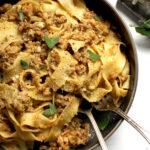
Ragù Bianco (White Bolognese Sauce) Pasta
Ragù bianco is a deeply satisfying, authentic Italian white ragù Bolognese pasta sauce with all the richness and flavor of traditional meaty Bolognese, but without tomato. This takes about two hours to prepare, but is worth every minute as the flavors of develop and the meat sauce becomes tender and rich.
Servings: 4 to 6 people
Calories: 1076kcal
Essential Equipment
- food processor the easy way to make the soffritto; otherwise, a box grater works great, too
- Large heavy skillet to make the white Bolognese sauce
- Large pot and colander for the pasta
Ingredients
For the Ragù
- 1 medium yellow onion, rough chopped
- 1 stalk celery, rough chopped
- 1 carrot, peeled and rough chopped
- 2 tablespoons extra-virgin olive oil
- 2 ounces pancetta, diced
- 1 1/2 pounds ground beef/pork/veal blend (if you prefer no veal, use 1 lb. ground beef and 1/2 lb. ground pork) also commonly known as "meatloaf mix"
- 1/2 cup white wine
- 2 cloves garlic, peeled and smashed
- 2 tablespoons finely-chopped fresh sage
- 2 tablespoons finely-chopped fresh rosemary
- 1/4 teaspoon fresh-ground nutmeg
- 1 1/2 teaspoons kosher salt (I use Diamond Crystal)
- 2 dozen turns fresh-cracked black pepper
- 1 1/2 cups unsalted chicken stock (added in stages)
- 1 cup whole milk (added in stages)
To Finish and Serve
- 1 pound dried pasta, such as pappardelle, tagliatelle, or rigatoni (fusilli could also work)
- Grated Parmigiano-Reggiano cheese
Instructions
- Make the soffritto. Place the chopped onion, celery, and carrot in a food processor and pulse until finely chopped. This is your soffritto.PRO TIP: If you don't want to use the food processor, you can leave the vegetables whole and grate using the large grates of a box grater, or finely dice everything by hand.
- Cook the pancetta and soffritto. Heat a wide-bottomed skillet over medium-low heat. Add the olive oil and pancetta and cook, stirring occasionally, until the fat renders, about 5 minutes. Add the soffritto. Increase the heat to medium and cook, stirring, until the vegetables are softened and the onions are translucent, about 5 minutes more. Spoon the soffritto and pancetta into a bowl and set aside.
- Brown the meat. Increase the heat to medium-high. Add the ground beef mix to the skillet and cook, breaking up the meat as much as you can, until browned. Do not stir too often so the meat can brown and develop good color and flavor.PRO TIP: This browning triggers the Maillard reaction, which creates the deep savory flavor of finished sauce.
- Deglaze with wine. Stir in the white wine, scraping up all the bits of meat. When the white wine has evaporated, lower the heat back to medium low.
- Build and begin the simmer. Add the soffritto, garlic, sage, rosemary, nutmeg, 1 teaspoon of kosher salt, and the pepper. Add 1 cup of chicken stock and about 1/3 cup milk. Give it a good stir, and partially cover the nascent ragù. You're on your way.
- First simmer: 30 minutes. Simmer, partially covered, for about 30 minutes, stirring once or twice. If it starts to look dry, dose it with some of the remaining chicken stock.
- Second simmer: 30 to 40 minutes more. Stir in an additional 1/3 cup milk and any remaining chicken stock. Simmer for an additional 30 or 40 minutes, partially covered, adding a little more liquid as necessary to keep things looking creamy, thick, and glossy -- neither too dry and crumbly, nor soupy. That gloss is your visual cue that the fat has emulsified properly and the sauce is ready.
- Cook the pasta. After the ragù has cooked for an hour or slightly more, it's time to start the pasta. Heat a large pot of well-salted water and cook the pasta until a couple minutes shy of al dente. Drain, reserving some pasta water.
- Finish the ragù. While the pasta cooks, add the final 1/3 cup milk to the ragù. Give it a final stir and taste for seasoning. I tend to add an additional 1/2 teaspoon kosher salt.
- Combine pasta and sauce. Remove about 1/3 of the ragù bianco from the skillet and set aside. Add the drained pasta to the remaining ragù along with 1/2 cup (more or less) reserved pasta water. Stir or toss the pasta with the white ragù for a minute or two until the entire thing marries together in perfect harmony and the pasta is perfectly cooked, adding a little pasta water as needed.
- Serve. Divide the pasta into bowls. Spoon a bit of the remaining white Bolognese on top of each bowl of pasta. Garnish generously with grated cheese and maybe a twist of pepper or two. Serve immediately.
Notes
Here are some important, helpful notes for this ragù bianco recipe, including substitutions, storage, pasta choice, and wine pairings.
Meat substitutions:
- Don't want to use veal? Use 1 pound ground beef and ½ pound ground pork.
- Pancetta: Thick-cut bacon works, though the flavor will be smokier so aim for uncured. Guanciale is an even more traditional option if available. For another traditional Emilia-Romagna preparation, add 1 to 2 ounces of minced prosciutto or mortadella to the meat mixture.
Nutrition
Calories: 1076kcal | Carbohydrates: 97g | Protein: 51g | Fat: 52g | Saturated Fat: 18g | Polyunsaturated Fat: 3g | Monounsaturated Fat: 24g | Trans Fat: 2g | Cholesterol: 140mg | Sodium: 1254mg | Potassium: 1058mg | Fiber: 5g | Sugar: 9g | Vitamin A: 2691IU | Vitamin C: 4mg | Calcium: 182mg | Iron: 6mg
Disclaimer: Nutrition information is provided for courtesy purposes only, and is an estimate not verified by medical or nutrition experts. Read the full nutrition disclaimer.
