A contributing essay for the Food+Grief Project, a special feature of Unpeeled Journal, where we publish writing, recipes, and resources exploring the connections between food and loss.
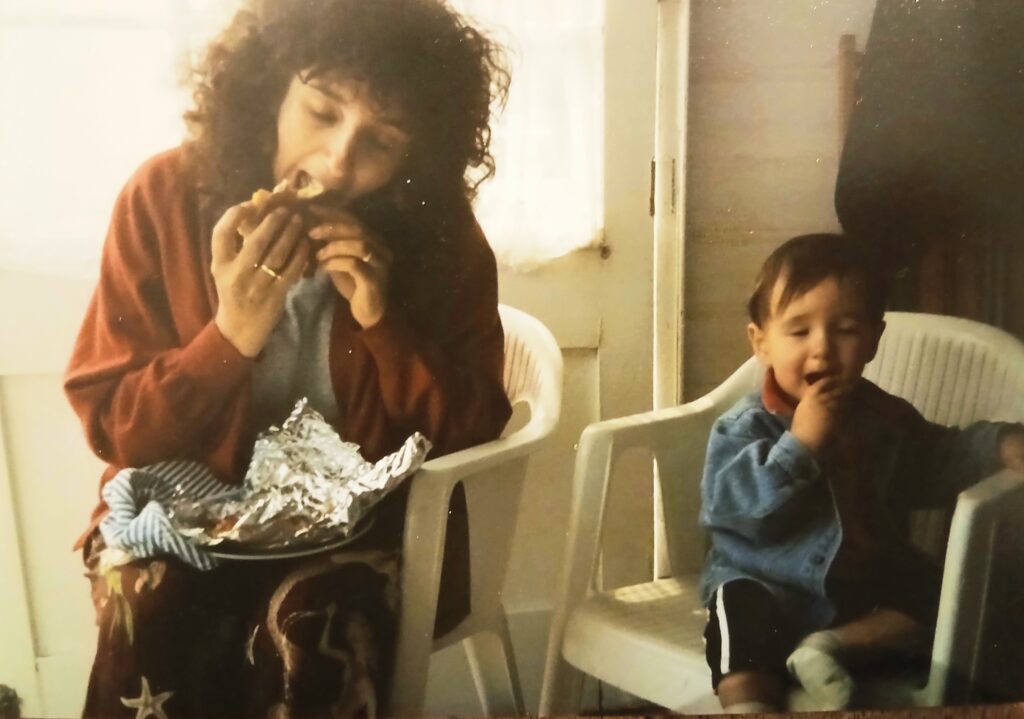
This month, we are honored to share the following contribution by British writer and journalist (yes, we kept the British spellings) Joe Sandler Clarke: an essay about losing his mother to cancer, and how a passion for food—eating, cooking, reading, discussing, sharing it—not only maintains a bond with her, but carries her legacy of love, expressed through food, forward to others.
I love the way Joe wrote this piece. His writing, so detailed, vulnerable, and true, transported me (as it will you) into his and his mom’s kitchen, and heart. These memories, shared so beautifully here, reminds us that in grief, the little things—a quick text message about falafel, a trip to the market—are so very, very big. Thank you, Joe, for sharing your beautiful story of food and grief.
–Lisa Ruland, Editor (January 2026)
Cooking With Mum: Joe Sandler Clarke’s Story of Food + Grief
After my mum’s funeral, I put a moussaka in the oven and waited for my parent’s house to be filled with the smell of tomato and garlic, as it had once been so often when I was a child. It was close to 9 p.m. by the time it was ready. I served the family and friends who remained in the living room and watched as they ate with the relish of people hungrier than they realised, given food tastier than they expected.
I longed for someone to notice something about the way it was cooked.
My mum used to tell me when I left home that she missed cooking for me because my dad didn’t give sufficient feedback. Raised on sugar sandwiches and post-war English “curries”—which consisted of meat, curry powder and, for some reason, dried fruit—he has never been interested in food. At least not in an obsessive way. He doesn’t have a list of his five favourite herbs, and he wasn’t excited when he heard Nora Ephron’s technique for frying mushrooms: only add butter when they’ve released their water and browned slightly.
My mum taught me how to chop onions, mince garlic, and make a French dressing. She told me to dispense with timers and use my senses to tell if something was cooked. Can you smell the garlic? Then add some liquid as any longer will burn it. Are the onions see-through? Then add the tomatoes.
I was an anxious child, and through these lessons, she coaxed me into the present.
You have to be in the moment to not burn spices and overcook fish. Colour equals flavour, so you should leave ingredients to fry instead of stirring all the time. Sometimes you have to let things be.
—
Up until my mum’s illness I had lived much of my life anxiously waiting for the next and better part of it to begin.
I hated going to parties so much as a child that each invite was traumatic. The morning before would involve my mum encouraging and negotiating with me to go. Her familiar reassurance that I “would like it when I got there” never seemed to take hold before the next invite, even though she was often proved right.
She wanted so much for her children to be out in the world, participating and flourishing as themselves, but there was nowhere I felt more comfortable than at home and in my own head. I spent a good portion of my childhood parading around the house dressed as various superheroes, including my own creation: a green-cape wearing crusader for justice who wielded my favourite vegetable as his “sword of truth.” When I retired Cucumber Man, I got into cooking. Making dishes with mum and learning from her.
Aged 13, I made Christmas dinner: gutting, scaling, and stuffing a turbot and serving it with a cream sauce and parmesan beans. The same year I made a paella with clams and prawns for two of my parents’ closest friends.
I grew up before programmes like MasterChef and The Great British Bake Off created junior spin offs. If those shows had been on TV back then, you would be able to go to YouTube and find teenage me having a breakdown over my Italian meringue being too crisp.
Mum took me to cookery expos at Olympia in Kensington and at Somerset House. At one of these events, the Italian chef Giorgio Locatelli, fresh from his first BBC TV series, handed me a signed copy of his book and a friselle, a soaked bread from Puglia served with tomatoes and olive oil. “One day I’ll be asking you for a job,” he said, declining my mum’s offer to pay and overestimating my staying power as an aspiring chef.
I would take cookery books down from my mum’s shelf and learn about new parts of the world and ingredients that hadn’t yet made it to the UK. One day I’d make it to these places and try these things, I thought, ignoring the world that could have been experienced then and there.
After escaping a day at secondary school, I would console myself with the fact that I only had a few more years until university and adulthood. At social events I’d count down the minutes until I could leave, get back home, and dice onions.
I found cooking grounding and transformative. Predictable and mood changing. Olive oil will emulsify when combined with pasta water, making a creamy sauce. Butter when taken to the edge of burning will smell of hazelnut. Garlic, ginger, and chili give the basis of many curries.
For my mum, food was a way for her to express her individuality and a door into other cultures.
For my mum, food was a way for her to express her individuality and a door into other cultures.
Aged 16 she told her family that she was a communist and had given up meat. My grandmother—an elegant Ashkenazi woman who had been sent to finishing school in Switzerland as a child in a bid to make her seem more English—responded by putting a raw artichoke in front of her and telling her she could have that for dinner. Months later, her parents sent her to the Soviet Union on a cultural exchange, reasoning that if she liked communism so much she could try living it for a few days. When she got home, she had only the clothes on her back, having found that in the Marxist economy, her belongings were more valuable than local currency. She got into Bennite socialism thereafter.
On Fridays and holidays, my grandmother would serve dishes like cholent—a beef and bean stew, tzimmes—another stew, this time with brisket, carrots, and prunes, and matzo ball soup. The rest of the time her cooking was refined and classically French. I’ve always thought my mum’s love of cooking came from someone else in her family. Maybe her grandmother who would wake her and her sister up on weekend mornings with lemonade and chips. Served in bed.
When she left this world of Friday night dinners, where most of her family lived on the same street in suburban Leeds, she became a skilled vegetarian cook, making dishes in the 80s and 90s that would be trendy now. Her butter bean casserole with basil butter is still a favourite of mine. She was supplementing dishes with tahini and yogurt long before Yotam Ottolenghi taught everyone to do that.
When she had a family, she would take us on weekend trips to the Diwana Bhel Poori House in Drummond Street, she would take me to the greengrocers next door to look at mooli, okra, and jackfruit, before heading into the restaurant for a masala dosa or matar paneer.
In my 20s, my mum and I would be excited to share our cooking triumphs with one another. “Look at my falafels,” she would text with a photo, having found a foolproof way to make them from scratch. “Come for dinner and try them.”
I could always go to my parents’ house for dinner. As I bounced around flatshares and tried to make a career as a journalist, I could always go home and cook or be cooked for.
At the start of the pandemic, I moved back in with my parents and would spend evenings in lockdown competing against mum to try perfecting a challah recipe. She went on Zoom to learn how to make jollof rice from a Nigerian friend. Food punctuated those months together, bringing us closer, and helping me relate to my parents as friends.
Before then, when the family was all together, we would finish one meal and then talk about what we would make for the next one. I still do this, frequently stressing my partner out by asking her what I should make for lunch as soon as we’ve finished breakfast.
—
Life was smaller when she was ill. My mood and how I interacted with the world was dictated more than I would like to admit by how well mum had seemed when I saw her last. Making it through a day, getting on with work, making dinner: It all required an impossible amount of effort after visits when I’d seen her stop a conversation to double over in pain. Her thick curly hair, now bright white. Her body frail and skeletal.
She was diagnosed with breast cancer in October 2021. In the nearly three years that followed, her life was gradually diminished until she could no longer eat or drink.
On trips home, when she was well enough and we would laugh and talk in the living room I would be desperate not to leave, even as I knew the journey home across London grew more difficult as the minutes ticked on. The next time I saw her she may not be as well, so couldn’t I stay a while longer?
When I went to see her, Mum would ask me what I’d been cooking and what I planned to make in the days ahead. I would tell her and she would offer additions and critiques, both of us knowing that we were participating in a kind of fiction. One where she was cancer-free, life was long, and we would cook and eat together again one day. Acknowledging the truth—that none of those things were likely to happen, that events outside of the immediate future would be impossible for her to attend, that when she mentioned a favourite dish of hers, she would never eat it again—was too much to think about, even though the thought was always there.
I remember last year walking to the park near my flat and being shocked that it was spring when it had been winter only days before. It was almost May. Time moved on and I seemed indifferent to it. Distracted. Forcing myself to be in the present.
On impossible days near the end, I would come home after work and make dinner for my dad. I would tell him with some pride that I didn’t need a recipe, before preparing a meal based on what he had in the fridge. Then I would go back to the living room to sit with mum. Neither of us had anything profound to say to each other. It was enough to sit. To let things be.
On impossible days near the end, I would come home after work and make dinner for my dad. I would tell him with some pride that I didn’t need a recipe, before preparing a meal based on what he had in the fridge. Then I would go back to the living room to sit with mum. Neither of us had anything profound to say to each other. It was enough to sit. To let things be.
In the weeks since she died, time has sped up suddenly, catching up on itself. Having numbed myself to the world I am now painfully aware of everything. Moved to tears by the most innocuous sounds, tastes and smells. It was summer and now, as I write this, it’s January. Knowing it’s a good idea to get out of the house, I have been to places across London where I think I’ll find her if I look hard enough.
The Diwana is one. The restaurant is the same today as when I was a child, even as the surrounding streets have been dug up and transformed for HS2. The pine tables and wood panelling still evoke a 1970s ski lodge. The windows still drip with condensation when the buffet is served on chilly weekend afternoons. The masala dosas still have the power to restore.
I expect to see her in Books for Cooks in Notting Hill, leafing through the new offering from Meera Sodha, or the farmer’s market in Marylebone where one grey autumn Sunday 20 years ago, we shared a grilled sardine sandwich—charred, salty, and elevated with a squeeze of lemon—that was a topic of conversation for the rest of her life.
I look for her at Beigel Bake in Brick Lane and only return to reality when I’m asked to stop dilly-dallying and make my order: chopped herring, her favourite.
She’s there when I look through my cookery books, many of which used to be hers and trace my fingers across the bumps caused by splashes of ingredients that cover our favourite recipes.
—
“I love the mustard in this,” one of my sister’s friends told me, halfway through his portion of moussaka. Maybe he noticed that I was searching the room for a compliment, like a hungry dog looking up from under a glass dining table. “Thank you,” I said, before going into too much detail about the other choices I’d made for the dish.
There is something blissfully distracting about cooking with skill. Making a sauce and knowing how to season it. Punching back a rested dough before making pizza. Seeing a recipe you thought of the night before come out perfectly the next day. Food is more than an escape or distraction. It is a way into the world. Trying something new and delicious can transform your day.
The real joy of knowing how to cook comes from seeing people you love enthusiastically eat something you prepared. That’s what mum was trying to show me as a child. Now when I see someone I care about be comforted by something I made for them, I’ll thank her.
Dedicated to Dianne Sandler, 15 January 1956 to 6 September 2024
Explore the full collection of essays and contributions to the Food + Grief Project. If you’d like to submit a piece for consideration, you can email us at inquiries[at]unpeeledjournal.com.