
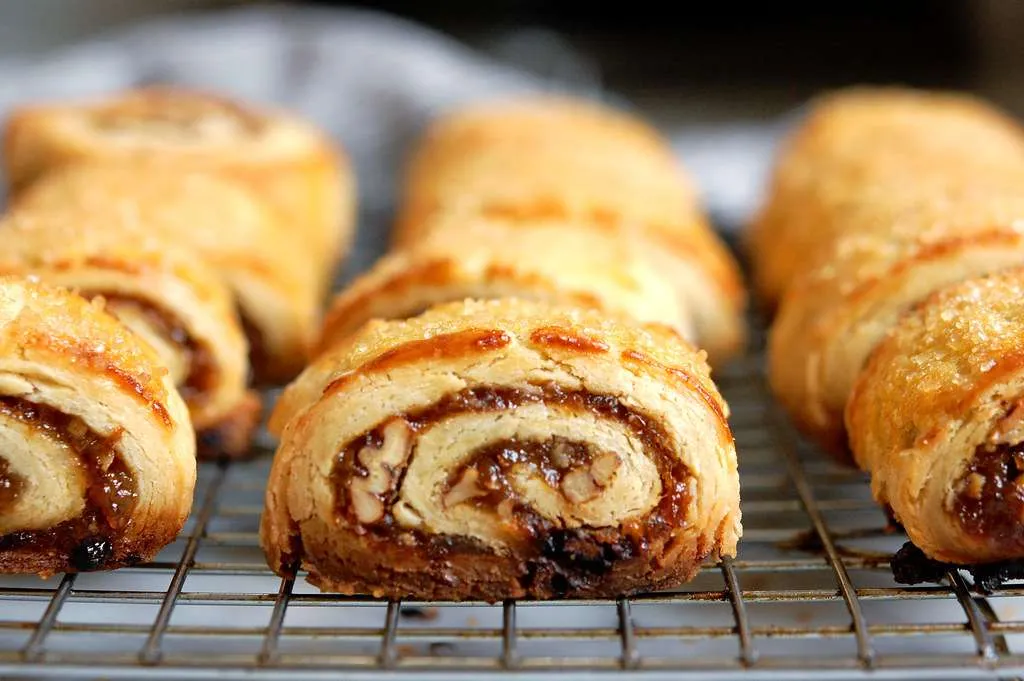
These traditional cinnamon rugelach cookies combine tender cream cheese pastry dough and a sweet raisin and walnut filling for a fabulous result, thanks to step-by-step directions and a key technique. Adapted by a pastry chef from Tracy Zabar’s beloved One Sweet Cookie cookbook, this is my go-to rugelach recipe for the holiday and beyond. Once you make them, it will be yours, too.
Jump To:
What Is Rugelach?
Rugelach, a Yiddish word meaning “little twists,” are traditional Jewish pastries made from tender, flaky dough that is rolled thin, filled, shaped into cookie-sized crescents or spirals, then baked. Modern versions often use cream cheese and butter dough for extra flakiness and ease of handling. With their sweet, cinnamon flavor and flaky texture, rugelach make a festive and traditional treat for the holidays.
Rugelach originated in Poland centuries ago. The crescent shape may have been an Austrian influence (such as with the croissant), though cut-log shapes are also common, like a Polish nut roll or Austrian strudel. Fillings typically include cinnamon sugar, chopped nuts, raisins, chocolate, or fruit preserves.
The buttery, melt-in-your-mouth rugelach we know today in America (a cream cheese dough rolled with filling and baked) was popularized in the 1950s through the 1970s, and is a popular addition to holiday dessert tables. This New Yorker rugelach article offers a great history of rugelach’s evolution into the modern pastry or cookie we know today.
Why This Cinnamon Rugelach Recipe Works
I have worked in New York City pastry kitchens and made holiday rugelach more times than I can count. I’ve also tasted plenty, thanks to all of the wonderful Jewish bakeries in New York. After much testing, this recipe for homemade cinnamon raisin rugelach cookies—adapted from Tracy Zabar’s One Sweet Cookie, a cookbook celebrating the recipes of the city’s celebrated bakers—is the one I always come back to. It’s the best.
Here is why this recipe works so well:
- The perfect filling technique: Unlike most recipes that use dry raisins, this recipes simmers the raisins in a cinnamon syrup first. This “plumps” the fruit so it doesn’t pull moisture away from the dough. Next, turning it into a spreadable paste allows easy, even spreading over the dough.
- Tender, flaky butter and cream cheese dough: The fat-to-flour ratio ensures that the cream cheese rugelach dough is easy to roll and bakes up perfectly tender and flaky.
- The “Log Method” Efficiency: While I’ll tell you how to do the traditional crescent, my (also traditional!) log-slice method ensures a better filling-to-dough ratio in every single cookie, and an easier, faster method to shape the cookies, then bake to a golden-brown finish crusted with sugar.
If you love a cinnamon swirl, you’ll love this recipe for Fluffy Cinnamon Rolls. And you’ll also love these cinnamon-y recipes for Overnight French Toast With Gooey Sticky Bun Topping, loaded with nuts and cinnamon, and Pumpkin Donut Muffins Rolled in Cinnamon Sugar.
Ingredients for Cinnamon Rugelach

Full quantities for these flaky little rolled pastries are in the recipe card below. Here are the ingredients you’ll need to make this traditional rugelach recipe, and why.
For the Cream Cheese Rugelach Dough
- All-purpose flour: Standard unbleached all-purpose flour provides the right balance of structure and tenderness. Do not substitute bread flour, which has too much protein and will make the dough tough.
- Sugar: Just a tablespoon. The dough itself is barely sweet; all the sweetness comes from the filling and the cinnamon sugar topping.
- Kosher salt: Balances and deepens the flavor of both dough and filling.
- Cold, unsalted butter: Cold is essential for a flaky pastry. Cubed, cold butter creates the steam pockets as the butter melts during baking. This gives these flaky rugelach their layered texture. Take it directly from the refrigerator; do not soften.
- Full-fat cream cheese: Use block-style, full-fat cream cheese only. I prefer Philadelphia brand. (Whipped cream cheese, reduced-fat cream cheese, or Neufchâtel all contain more water and will result in sticky dough.)
- Egg yolks: Two yolks add richness and help bind the dough without adding water.
For the Cinnamon, Raisin, and Walnut Filling
- Golden raisins: Milder, plumper, and with a better sweetness than standard dark raisins. Either will work, though, or use a mix. This is also where you can substitute currants, chopped dried cherries, or chopped dried apricots.
- Light brown sugar: Adds a gentle molasses warmth that deepens the cinnamon note in the filling
- Kosher salt: A small amount in the filling is important; it keeps the sweetness from being flat
- Cinnamon: Use good-quality cinnamon. This gives the rugelach its aroma.
- Pure vanilla extract: Amplifies the warm spice quality of the cinnamon filling. Use pure extract, such as McCormick’s (a favorite), not imitation.
- Walnuts or pecans: Walnuts are traditional and contribute a slight earthiness that balances the sweet filling beautifully. Pecans are richer and buttery. Use whichever you prefer, or a combination.
To Finish the Rugelach Cookies
- Egg yolk (for egg wash): Gives the baked rugelach cookies a golden color and ensures the topping sugar adheres to the dough.
- Demerara or cinnamon sugar: Demerara is best; its large crystals add crunch and a slightly caramel quality. Cinnamon sugar is a more traditional and equally delicious choice.
Other Popular Rugelach Fillings: Substitutions and Variations
If you’d like to vary the ingredients, instead of cinnamon raisin rugelach, you can swap this recipe’s filling for these versions:
Different dried fruit: Dried fruits like currants, dried tart cherries, chopped dried apricots, or dried cranberries all substitute 1-for-1 for the golden raisins. Keep the total quantity the same.
Apricot rugelach: Skip the cooked raisin filling. Instead, spread the rolled dough with a thin layer of good-quality apricot jam, then sprinkle with finely chopped walnuts and a generous pinch of cinnamon sugar before rolling. This is a wonderful, classic variation, simpler and quicker than the full raisin-walnut filling.
Chocolate rugelach: Spread the brown sugar filling over the dough, then sprinkle with finely-chopped bittersweet chocolate or chocolate chips. Roll, chill, slice, and bake as directed.
Crescent-shaped rugelach: To make the traditional crescent shape rather than the log-cut spiral, spread the filling over the rolled dough, then use a sharp knife or pizza cutter to cut the dough into long triangles (widest at one end, tapering to a point). Roll each triangle tightly from the wide end toward the point. Chill and bake as directed.
Nut variation and nut-free rugelach: Substitute pecans instead of walnuts, or simply omit the nuts altogether. The cooked raisin-and-cinnamon filling is rich and delicious on its own and holds together without the nuts. Substitute chopped seeds like plain pumpkin or sunflower seeds if you want the nutty texture without the nuts.
Gluten-free rugelach: You can make this gluten free with a high-quality 1:1 gluten-free flour blend for the dough. My go-to brands are Cup 4 Cup and King Arthur. The dough will be more fragile, though, so handle it gently and keep it well-chilled.
And learn how to make cinnamon sugar here. You may also love
How to Make Rugelach: Step by Step
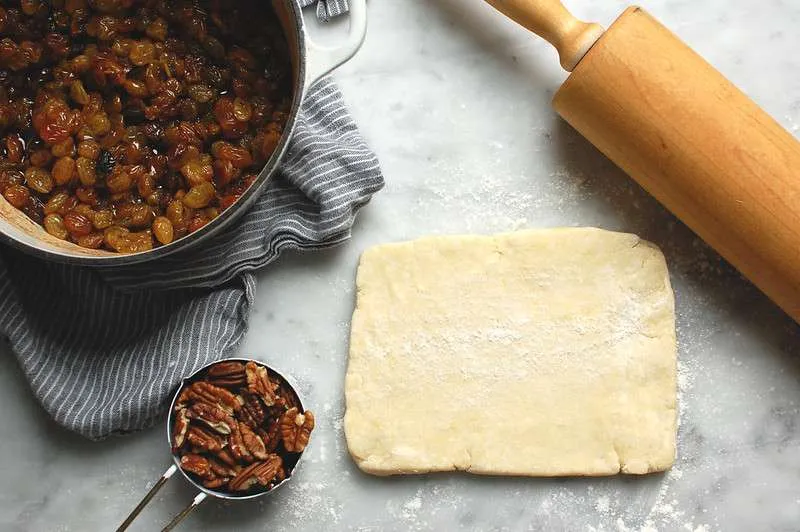
The short version: make and chill the dough, cook the filling, roll and fill the dough into a log, chill again, slice and bake. None of it is difficult; it just requires planning for the chilling time.
Equipment of Note: Food processor, rolling pin, sharp knife, parchment-lined baking sheet, and a small offset spatula for spreading the filling. A clean, 12-inch ruler is useful for even slicing.
Step 1: Make the Flaky Cream Cheese Rugelach Dough and Chill
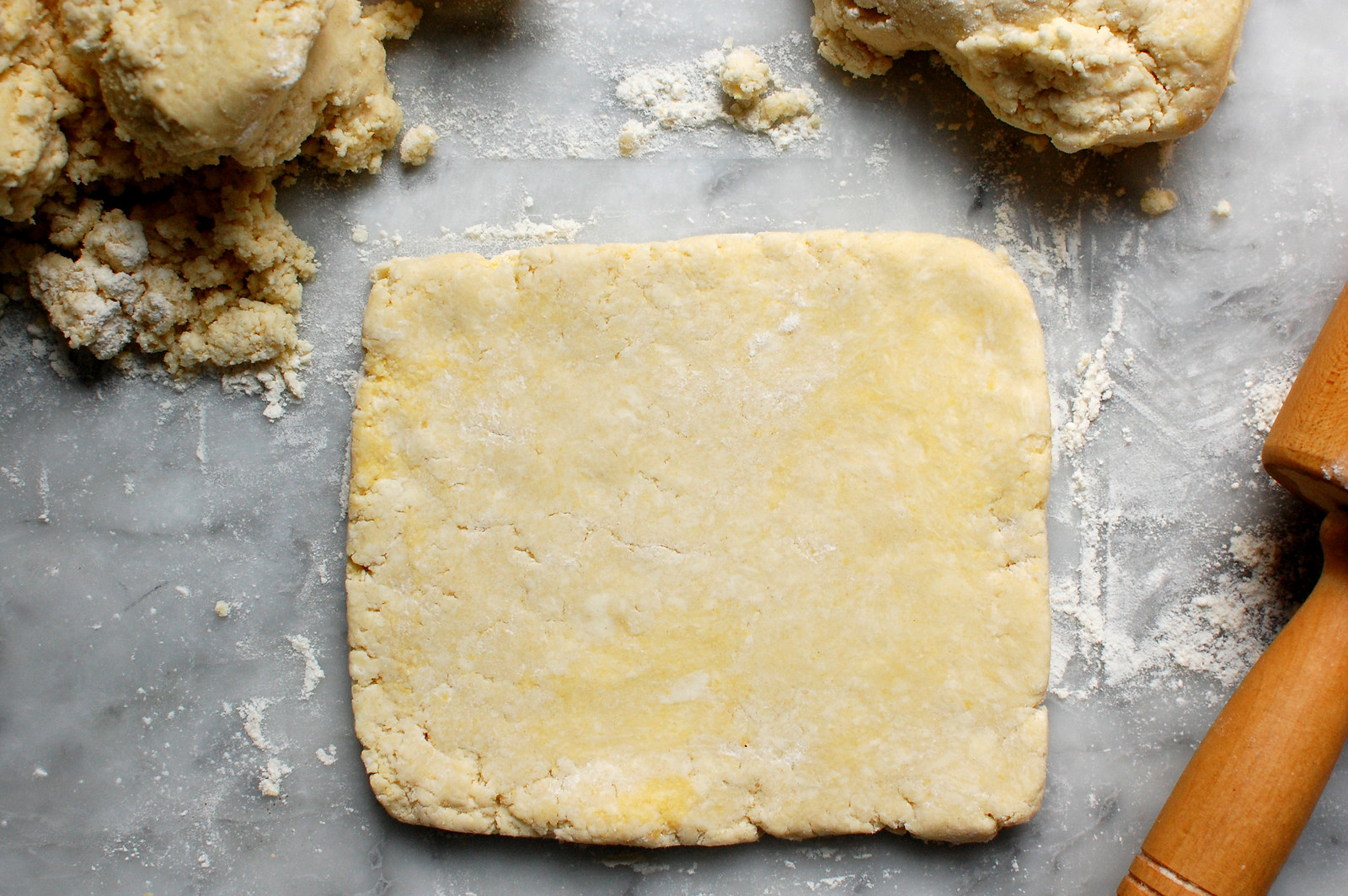
Pulse the flour, sugar, and salt in the food processor. Add the cold cubed butter, cream cheese, and egg yolks. Pulse until the mixture just comes together in a shaggy, crumbly mass. Turn out onto a lightly-floured surface (the pros call this dusting flour “bench flour”) and knead gently, just until it forms a cohesive dough. Knead lightly to prevent gluten development and keep the fat cold. Divide the cream cheese rugelach dough into thirds, flatten each section into a thick rectangle, wrap, and refrigerate for at least 1 hour or overnight.
Pro Tips: Dividing the dough into thirds (rather than halves) makes the dough easier to roll and keeps it colder throughout. The butter must be cold, so that the dough becomes flaky when baked. Speaking of flaky dough, here’s how to make perfect, flaky pie dough from scratch.
Step 2: Make the Cinnamon Raisin Filling
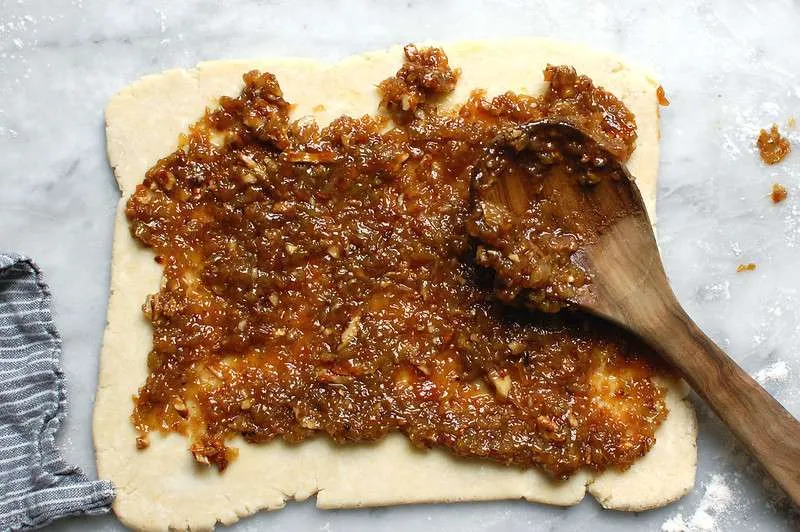
This is the very easy part! Place raisins, brown sugar, salt, cinnamon, and vanilla in a small saucepan with just enough water to cover. Bring to a boil, then simmer until the water is nearly gone and the raisins are plump, soft, and glossy. Transfer to the food processor (leave any syrupy liquid behind) and blend into a thick paste. Add walnuts and pulse a few times–don’t over-blend; you want small nut pieces to remain, not a smooth paste.
Pro Tip: Cooking the raisins first is the step that sets this recipe apart. Dry raisins pull moisture from the dough during baking; these pre-cooked raisins stay soft and the filling stays put.
Step 3: Roll, Fill, and Shape the Logs
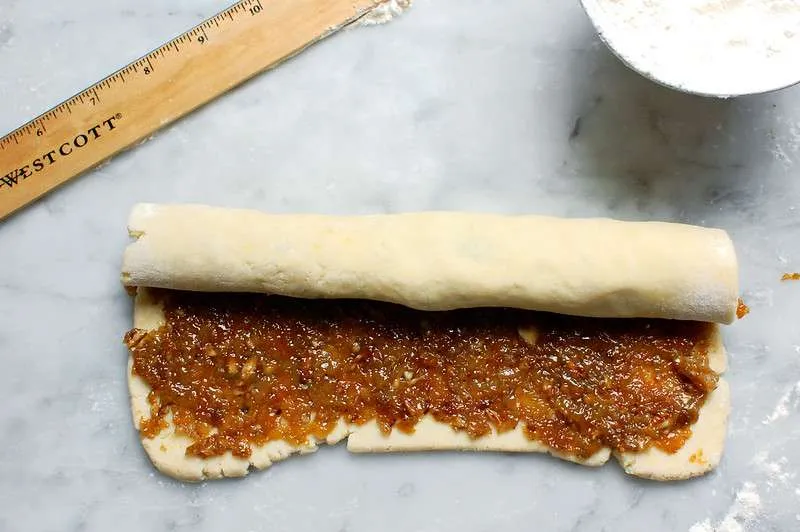
Working with one dough rectangle at a time (keep the others refrigerated), roll out on a lightly-floured surface to just under ¼-inch thick, long sides horizontal. Spread one-third of the filling in an even layer, leaving a thin bare strip along the far edge (to seal the dough). Starting at the far edge, roll the dough tightly toward you into a compact spiral log.
Transfer, seam-side down (to prevent unraveling), to a baking sheet, cover, and refrigerate. Repeat with remaining dough. Chill logs at least 30 minutes, preferably 1 hour.
Pro Tip: Roll tight from the very first edge. A loose start is the main reason rugelach unroll during baking.
Step 4: Slice, Top, and Bake

Preheat the oven to 325°F. Brush the chilled logs with egg yolk and sprinkle generously with Demerara or cinnamon sugar. Using a sharp knife–wipe it clean between cuts–trim the ragged ends, then slice into 1¼-inch pieces. Place cut-side down on a parchment-lined sheet, spaced 1 inch apart. Bake for 25 minutes, rotating halfway, until deep golden brown. You now have a batch of traditional Jewish rugelach. Cool fully on a wire rack.
Pro Tip: A clean knife gives you a sharp, clean, defined swirl with no mess.
Crescent vs. Log Shape: Why I Prefer the Slice-and-Bake Method
Traditionally, many rugelach recipes have a mini croissant shape. Croissant-shaped rugelach are made by 1) rolling the dough into a circle, 2) spreading the filling, 3) cutting the dough into triangles like a pizza (in fact, a pizza cutter works great), and 4) rolling.
But I prefer these nice, even log cuts instead. Here’s why log-slice cuts of rugelach are best: Log slices are also traditional, and used in many Jewish households and bakeries, including institutions like Zabar’s. Further, cutting the rolled dough into straight-sided swirls shows off the rolled pattern, and is less time consuming to shape.
While we’re talking cookies, be sure to get the full Unpeeled Journal roundup of the Best Holiday Cookie Recipes. These buttery Pecan Shortbread Cookies are one of my favorites, also loaded with nuts.
Make-Ahead Rugelach Cookies, Storage & Freezing
Rugelach are one of those cookies that benefits from a little advance planning, and are a great make-ahead holiday cookie, when things get so busy. The dough, filling, and assembled rugelach freeze well both raw and after baking. Here’s how to work ahead and store them as needed.
Make the Dough and Filling in Advance
Refrigerate the dough: The cream cheese dough can be prepared up to 2 days ahead, flattened into rectangles, and kept tightly wrapped in the refrigerator. If the dough feels very firm, let it sit at room temperature just until pliable, but still cool to the touch.
You can also freeze the dough: Wrap dough disks tightly in plastic wrap and freeze for up to 2 months. Thaw overnight in the refrigerator before rolling. Keep the dough slightly cool while rolling for best results; warm dough can become sticky and difficult to handle.
The raisin-nut filling: The filling can be made up to 2 days in advance and kept in the refrigerator in an airtight container. It also freezes well. Bring to room temperature and stir before spreading.
Freezing Unbaked Rugelach
You can also freeze shaped, unbaked cookies:
- Arrange on a parchment-lined sheet and freeze until firm.
- Transfer to an airtight container or freezer bag.
- Bake directly from frozen, adding 2 to 3 minutes to the usual bake time so the frozen centers bake fully.
Freezing Baked Rugelach
Cool the cookies completely before freezing. Store in an airtight container for up to one month. To refresh, warm briefly in a 300 degree Fahrenheit oven for 5 to 7 minutes. The rugelach will taste just baked, with that tender, flaky texture intact.
Storage Tips
Once baked and cooled, store at room temperature in an airtight container for 4 to 5 days. Avoid refrigerating, which will make the cookies stale and dull the flavor.
Troubleshooting, Expert Tips & F.A.Q.s
Even a classic raisin rugelach recipe can have hiccups. Here are the most common issues and professional solutions, plus tips to ensure every batch turns out tender, flaky, and perfectly shaped.
- Slicing tips: I use a clean ruler when slicing the rolled cookies to ensure that each cookie has the same width. Make sure to wipe the knife clean with each cut.
- If the dough is sticky or hard to roll: Sticky means it’s too soft, or there is not enough flour dusting the rolling surface or dough minutes. Make sure the dough is chilled, then roll on a lightly-floured surface, working one portion at a time. Cold dough maintains the flaky layers.
- If your cookies spread too much: the dough was too soft or overworked. Chill the shaped rugelach for at least 30 minutes before baking, preferably one hour.
- If you have underbaked or doughy cookies: The listed bake time should be correct, but ovens vary. Bake until the tops and edges are golden and bottoms deep golden brown. Cool on a wire rack so air can circulate on the bottom, preventing condensation. Cookies firm as they cool.
This is a common rugelach problem, and it almost always comes down to one of two things: the log wasn’t rolled tightly enough, or it wasn’t cold enough when it went into the oven. Roll firmly from the very first edge of dough, and place the seam on the bottom to make a seal. After rolling, chill the log until it’s genuinely firm (at least 30 minutes; an hour is better) before slicing and baking.
Yes! Make-ahead rugelach are easy. Cream cheese dough can be prepared up to 2 days in advance and kept tightly wrapped in the refrigerator. Divide into disks for easier rolling, and always keep it cold to maintain flaky layers.
Absolutely. Wrap dough disks tightly and freeze up to 2 months. Shaped but unbaked rugelach can also be frozen and baked directly from the freezer (add 2 to 3 minutes baking time). Baked cookies freeze well for up to 1 month. Thaw at room temperature, not in the fridge. You can also refresh them in a 300°F oven for a few minutes to restore flakiness.
Overfilling or spreading filling to the edges can cause leaks. Use a thin, even layer, leave a small border, and chill shaped cookies before baking. Slight caramelization at the edges is normal and adds flavor.
Classic cinnamon, raisins, and walnuts are perfect, but you can swap walnuts for pecans, hazelnuts, or almonds, or try dried cranberries, currants, or chocolate in place of raisins. Keep fillings finely chopped and not overly wet to keep the right consistency.

Love this old fashioned cinnamon rugelach cookies recipe? Here’s more holiday baking you’ll love:
- Snowballs (Mexican Wedding Cookies)
- Soft Italian Sprinkle Cookies
- Soft Molasses Spice Cookies
- Slice-and-Bake Butter Cookies
And if you made this rugelach recipe, be sure to leave a review and a comment below!

Cinnamon Rugelach Cookies
Essential Equipment
- 1 standard, 12-inch ruler
- 1 food processor
- 1 pastry brush
Ingredients
For the Cream Cheese Rugelach Dough
- 2 1/4 cups all-purpose flour
- 1 tablespoon sugar
- 1/4 teaspoon kosher salt
- 8 ounces (2 sticks) cold, unsalted butter, cut into pieces
- 8 ounces (1 block) cream cheese, cut into pieces (I use Philadelphia brand)
- 2 egg yolks
For the Cinnamon Rugelach Filling + to Finish
- 12 ounces golden raisins
- 1/4 cup light brown sugar
- 1/8 teaspoon kosher salt
- 1 teaspoon cinnamon
- 1 1/2 teaspoons pure vanilla extract
- 1/2 cup pecans or walnuts
- 1 whisked egg yolk, for egg wash
- Demerara or cinnamon sugar, for topping
Instructions
For the Cream Cheese Rugelach Dough
- Pulse the flour, sugar, and salt in the bowl of a food processor until mixed. (You can use a whisk and large mixing bowl.) Add the cubed butter, cream cheese, and egg yolks. Pulse in the food processor until the dough comes together as a crumbly dough.
- Turn the dough out onto a clean, lightly-floured surface. Gently knead the dough a few times to bring it together. Divide into thirds.
- Shape each dough into a thick, flattened rectangle. You can use your palm, but I prefer a rolling pin. Wrap and chill for at least one hour. Repeat with the remaining dough.
For the Cinnamon Rugelach Filling
- While the rugelach dough rectangles chill, make the filling. Put the raisins, brown sugar, salt, cinnamon, and vanilla in a small pot. Cover with just enough water to submerge the raisins.
- Bring the raisin mixture to a boil, then lower to a simmer and cook, stirring occasionally, until most of the water has fully evaporated and the raisins are plump and soft. You should see a thickened syrup at the bottom of the pot. Don't cook beyond this, or you risk burning the raisins.
- Transfer the raisin mixture to the bowl of a food processor, leaving behind the syrupy liquid. Blend until the mixture forms a thick spread. Add the nuts and blend again to combine.
To Finish
- Lightly dust the countertop and your dough with flour. Roll the first dough into a neat rectangle slightly less than 1/4" thick. The wide sides should be your top and bottom. Rolling cream cheese rugelach dough thin ensures delicate spirals.PRO TIP: I always keep a clean 12" ruler in my kitchen tools. In addition to taking measurements, it also acts as a useful straightedge for scraping a countertop, or cutting pastry against.
- Spoon a third of the raisin nut filling all over the surface of the rugelach dough. PRO TIP: I like to use my indispensable small offset spatula to spread the filling, but the back of a spoon will work, too.
- Starting from the top of the dough and working toward you, roll the dough tightly to make a spiral log. Transfer the log, seam side down, onto a baking sheet. Cover and chill. Repeat with the remaining rugelach dough and filling. Chill for at least 30 minutes, preferably 1 hour.
- Preheat the oven to 325°F.
- Remove the chilled dough from the fridge. Brush the top and sides of each log with the egg yolk, and sprinkle generously with your choice of demerara, sparkling, or cinnamon sugar.
- Using a sharp knife, trim the shaggy ends from each log. Slice the rugelach into 1 1/4" wide pieces. Place each raw cinnamon rugelach cookie on a greased or parchment-lined baking sheet, seam down, each spaced about 1" apart. PRO TIP: Make sure you wipe your knife clean as necessary as you cut to give the rugelach clean edges.
- Bake, rotating half way, for about 25 minutes, until golden brown.
- Transfer to a cooling rack. Cool fully before serving. The rugelach will keep in an airtight container for about 5 days, and freeze well.
Notes
- The nuts: Pecans and walnuts can be used interchangeably
- The fruit: Purple raisins, currants, or dried cranberries can be substituted for golden raisins.
Nutrition
Disclaimer: Nutrition information is provided for courtesy purposes only, and is an estimate not verified by medical or nutrition experts. Read the full nutrition disclaimer.
Why You Should Trust This Rugelach Recipe: This recipe was adapted and tested from scratch by Lisa Ruland, a Culinary Institute of America pastry school graduate (valedictorian), Level 2 WSET-Certified Wine Professional (With Honors) and professional food writer and pastry chef. I am committed to providing accurate, trustworthy culinary guidance based on years of hands-on experience in professional and home kitchens. Learn more about Lisa’s expertise.








18 comments
Dorit
I made these today with a preserves filling and was but the preserves leaked. Any idea what i did wrong?
Lisa Ruland
Hi, Dorit. Sorry to hear you had an issue with your preserves leaking. There were likely two possible culprits: one would be overfilling the rugelach with jam. When heated, preserves become more liquified and can drip/leak out of the seams, even if they seemed well-contained when you rolled them. The other main possibility is that the preserves contained too high of a ratio of liquid. If the preserves seem naturally “loose,” especially at room temperature, it’s possible that you may have to reduce them over the stove a bit to evaporate some excess liquid. I find that strawberry preserves are especially prone to this. I hope this helps! Let me know how it goes if you try again.
NYLilian
Greetings from NYC! I love Zabar’s rugelach. I know this isn’t the store’s recipe, but I love this Tracy connection. Will have to buy this book. Anyway, looking forward to trying these. My mother always used purple raisins, but I think golden taste better. Thanks!