
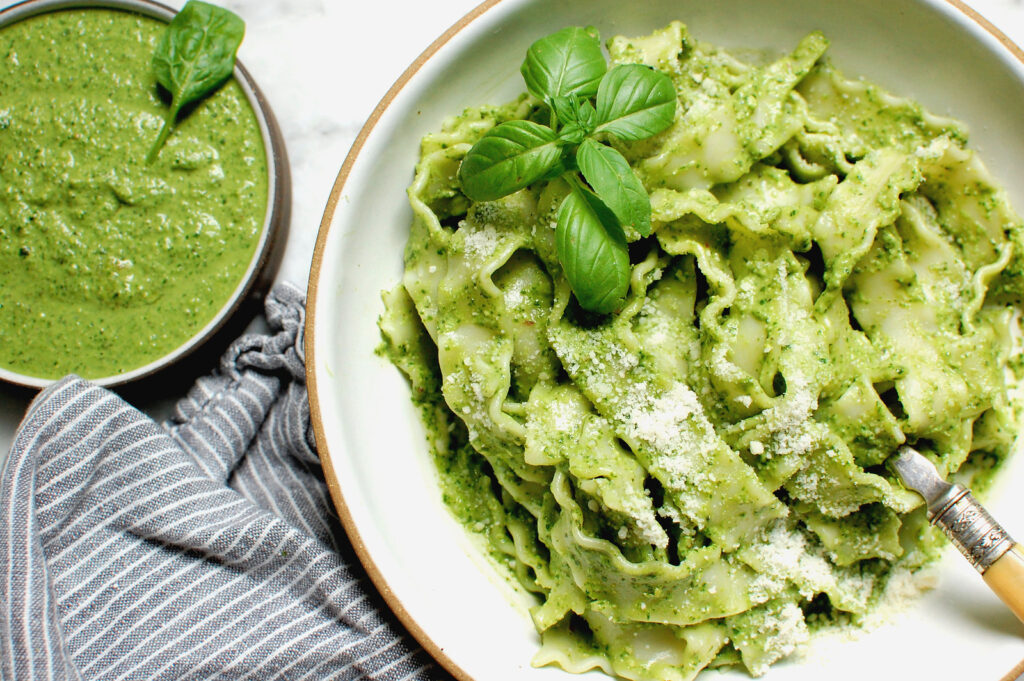
This basil pesto recipe won the World Pesto Championship in Genoa, Italy, the birthplace of pesto. Now you can make it right in your home kitchen. Adapted from Italian chef Paolo Laboa, the secret to the silkiest, freshest, best-tasting pesto is one special technique, plus six classic ingredients.
Jump To:
Quick View: Why This Recipe Really Is the Best
- It won the highly-respected World Pesto Championship in Liguria, Italy, where basil pesto was born
- A cold-temperature chef technique keeps the pesto vivid green and bitterness-free
- Easy to make: six ingredients, 15 minutes, no cooking
- Yield: 1 1/4 cups, the exact right amount for a pound of pasta
Where This Basil Pesto Recipe Comes From
Food writing is full of hyper-enthusiastic hyperbole and puffery. You know what I mean: “Guaranteed the best, most delicious [insert food] ever!” That kind of thing. Except sometimes, it is an actual fact. Sometimes, you really do get the world’s best basil pesto recipe. The one that actually won the award in Italy, at the World Pesto Championships. And now this recipe is yours.
Winning the World Pesto Championship in the Liguria region of Italy, the birthplace of Genovese basil, is like winning the World Cheesesteak Contest in Philadelphia. (Which, to my knowledge, does not exist, but should.) In other words, if you win it there, you really are the world’s best. Now you can make this silky, fresh, absolutely delicious pesto at home.
This recipe belongs to Italian chef Paolo Laboa, and before that, to his mother. Laboa was running the kitchen at Farina in San Francisco in 2008 when his family recipe took the Italian world championship. He now cooks at Solo Italiano, a rustic Italian restaurant in Portland, Maine, where the pesto pasta is a favorite menu item. That’s where I first tasted it. The pesto was, and is, silkier than any basil pesto I’d ever eaten, and a soft, fresh green color, with none of the flat bitterness that creeps into many versions (hint: it’s too much garlic and bad pine nuts).
I went home determined to get the recipe and techniques. And I found it! The answers lie in a combination of some cool — literally — technique, and the use of the very, very best ingredients: the right basil, the right olive oil, and the right cheeses.
What Is Authentic Basil Pesto?
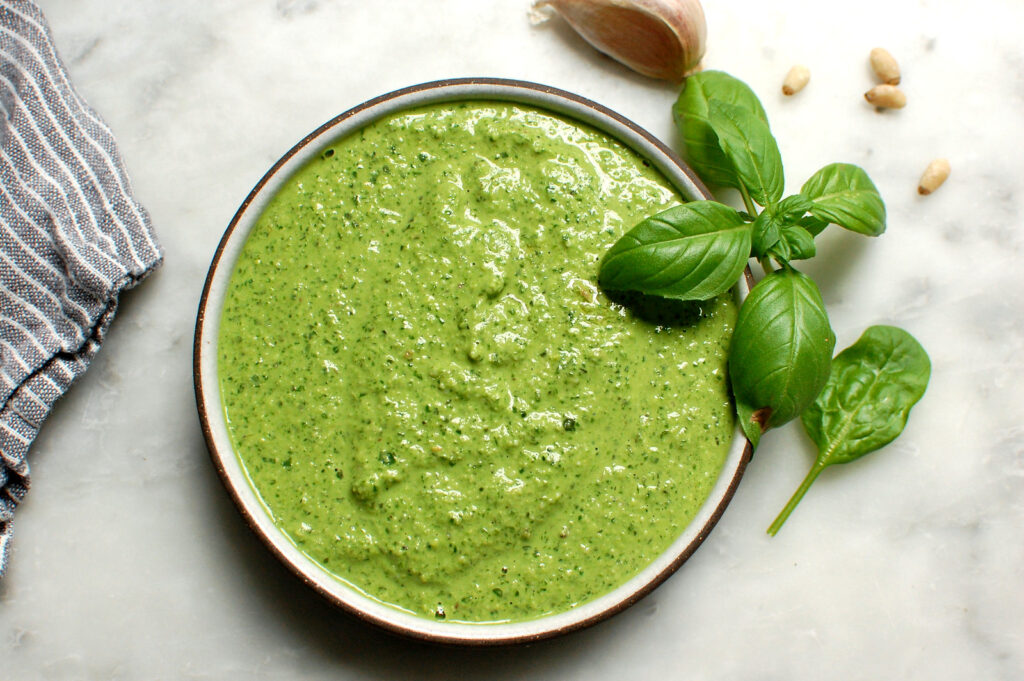
Basil pesto (pesto Genovese, or pesto alla Genovese) is an uncooked sauce originally from Genoa, Italy made of fresh basil, pine nuts, garlic, Parmigiano-Reggiano and Pecorino cheeses, and extra-virgin olive oil. The name comes from the Italian pestare, meaning “to pound” or “to crush.” Traditionally, the sauce is worked by hand in a marble mortar with a wooden pestle, which the World Pesto Championship still requires.
At home, a blender does the job beautifully (though perhaps not as classically), and that’s what we use here for the silkiest texture. Even Chef Laboa, in the Portland Press Herald article, says, “I think 200 years ago, if they had a blender, they’d use a blender.”
Because pesto is never cooked and contains so few ingredients, it’s important to do this right: the quality of ingredients matter, and so does Chef Laboa’s special winning technique.
The Technique That Makes This Pesto Different
Most Italian basil pesto recipes tell you to rinse the basil and blend everything together. This one does one thing differently, and it makes a difference.
Winning Technique #1: Soak the Basil in Cold Ice Water
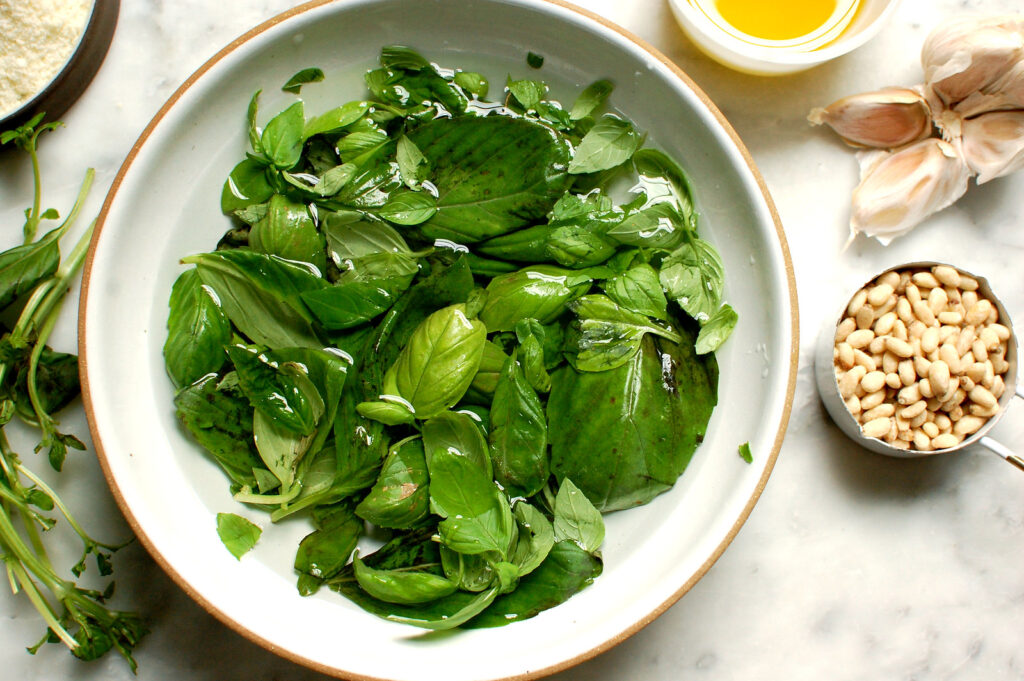
Soak the basil leaves, fully submerged, in cold ice water for 10 to 15 minutes before blending. You want to give it a full soak, not a rinse.
The soak does two jobs: 1) cleaning the basil leaves, and 2) preventing oxidization. Basil can be sandy, and an underwater bath gets all the dirt, grit, and sand out, which will settle to the bottom.
As importantly, the cold water chills the leaves, which slows oxidation — the process that turns basil brown and gives most homemade pesto its faint bitterness. Cold basil oxidizes more slowly. Additionally, the water still clinging to the leaves when they go into the blender acts as an emulsifier with the olive oil, (kind-of as a secret “non” ingredient), which is where that silky texture comes from.
Bonus Technique #2: Chill the Blender Bowl
This step is more optional because blending happens quickly, but bonus points if you also chill the blender bowl and blade. Blender motors generate heat, and heat can undo what the cold soak just accomplished. Chef Laboa freezes his blender bowl before making pesto. If you have the freezer space, do that. If you don’t, just fill the blender with ice and cold water, let it sit five minutes, dump it, and blend immediately. The bowl should feel cold to the touch when you start.
These two steps are why this pesto comes out a vivid, perky green color and tastes so smooth.
Basil Pesto Ingredients: What to Use
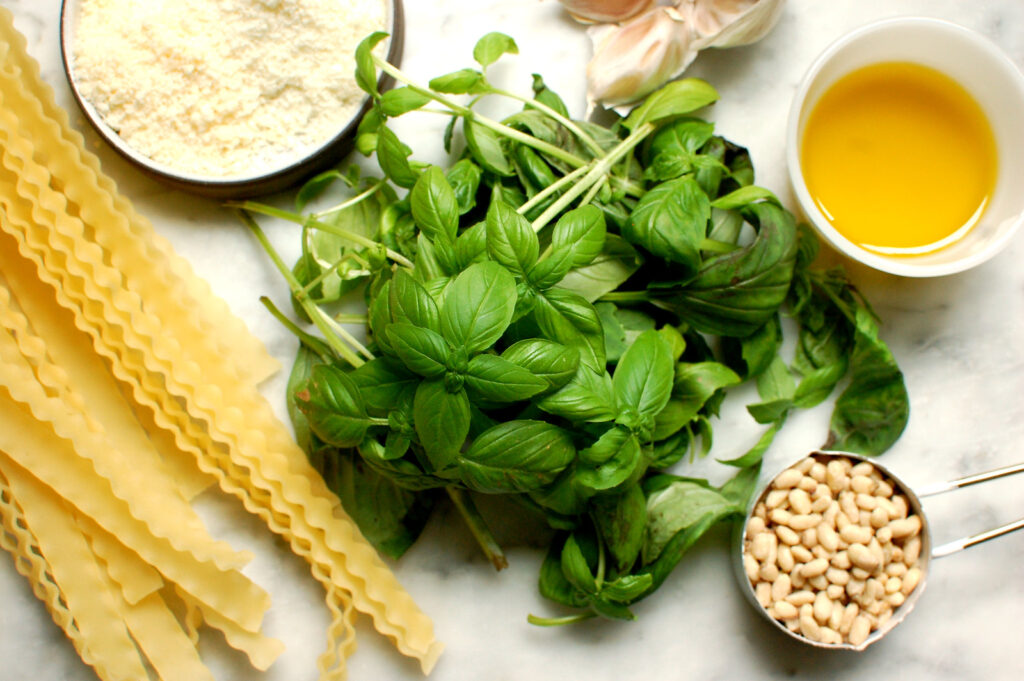
As noted above, this recipe uses the very, very best ingredients: the right basil, the right olive oil, and the right cheeses. If you want to go for the gold and make the world’s best basil pesto recipe to the exact specifications, here is where you can source the ingredients:
The Basil
Chef Laboa uses young Genovese basil. Luckily, Genovese basil is the most common type of basil you see in the store. Ideally, Laboa makes sure to use only young, bright green leaves, and not the large, tougher, dark-green leaves. He says that these bigger leaves have a different, less delicate flavor. If that is the Genovese basil you can find, however, it will still be great. Just avoid other types of basil, such as Thai basil.
You might also like: How to Store Fresh Herbs (Including Basil)
The Pine Nuts (Pignoli)
Traditional pesto Genovese uses Italian or Portuguese pine nuts, which are smaller, creamier, and more buttery than the Chinese-grown pine nuts in most supermarkets. If you want to source these online, Gustiamo and Nuts.com both carry Italian pignoli.
That said: standard pine nuts make a very good pesto. Use what you can get. If you have a nut allergy, raw, unsalted pumpkin seeds make a nice alternative.
The Two Cheeses: Parmesan and Pecorino
I am never in favor of sub-par Italian grated cheeses, perhaps especially with pesto, which relies so much on the flavor of the cheese. You will taste the difference. For this recipe, you need two cheeses, in equal measure:
- Parmigiano-Reggiano: Try to source actual Parm-Regg (the cheese aged 12 months has a nice balance; 24-month will have more sharpness). If possible, avoid domestic or generically-labeled “parmesan.” Grating it fresh is best, since pre-grated Parmigiano may be drier and not blend as smoothly, but either works.
- Pecorino Sardo or Pecorino-Toscano: These are less familiar vs. the more common Pecorino-Romano. Toscano is a sheep’s milk cheese from Tuscany, and tastes softer than Pecorino-Romano. If you can find it, great. If you can’t find it, Pecorino-Romano (often sold as Locatelli) is the right substitute; just cut the salt in the recipe by about ¼ teaspoon, because Romano is saltier.
The Olive Oil
Use a fruity, mild extra-virgin olive oil. Avoid a bold, peppery bottle (though I do love that for dipping bread), which will overwhelm the basil. If you really want to go full A.P. Pesto, Ligurian oil is the traditional choice, but any good, mild extra-virgin oil will make an excellent pesto.
The Garlic
The recipe calls for one-third of a small fresh clove — basically a sliver. There is such a small amount of garlic in this that originally, I thought it was a mistake. But it’s exactly the right amount of garlic. Raw garlic, like raw onion, has a sharp bite. This hint of garlic adds a complementary flavor without being overpowering or biting.
How to Make Basil Pesto, Step by Step
The full recipe with exact quantities is in the card below, but here’s a good overview to get you oriented.
Step 1: Soak the basil. Submerge the basil leaves in a bowl of cold ice water for 10 to 15 minutes. Reserve a few tablespoons of the soaking water; you may need it to loosen the blend.
Step 2: Chill the blender. While the basil soaks, fill the blender bowl with ice water and let it sit for 5 minutes. Empty it just before blending.
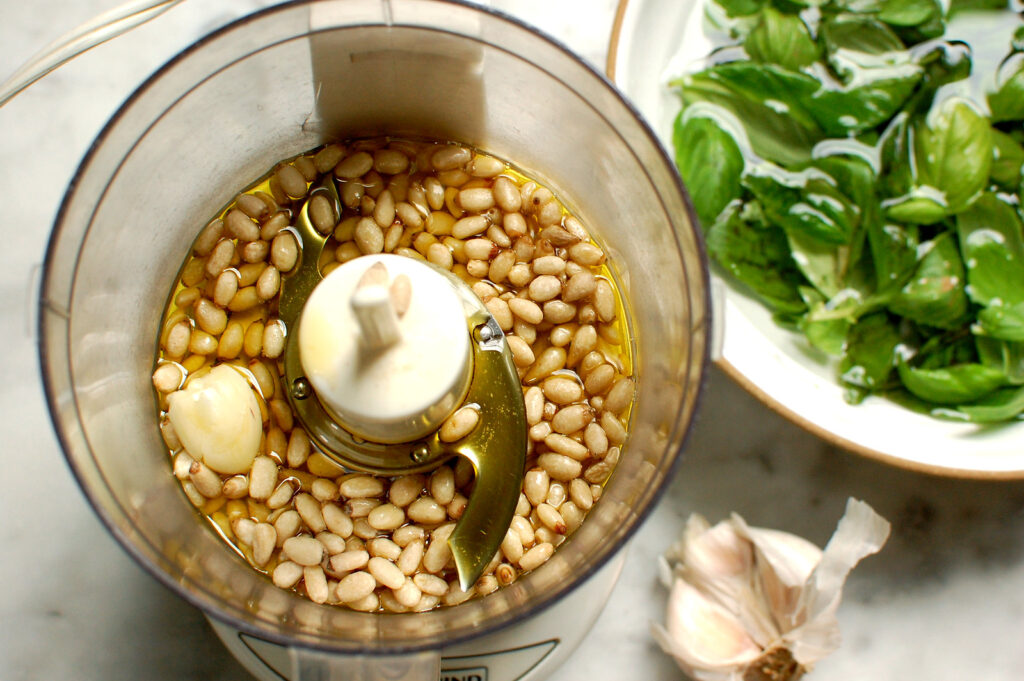
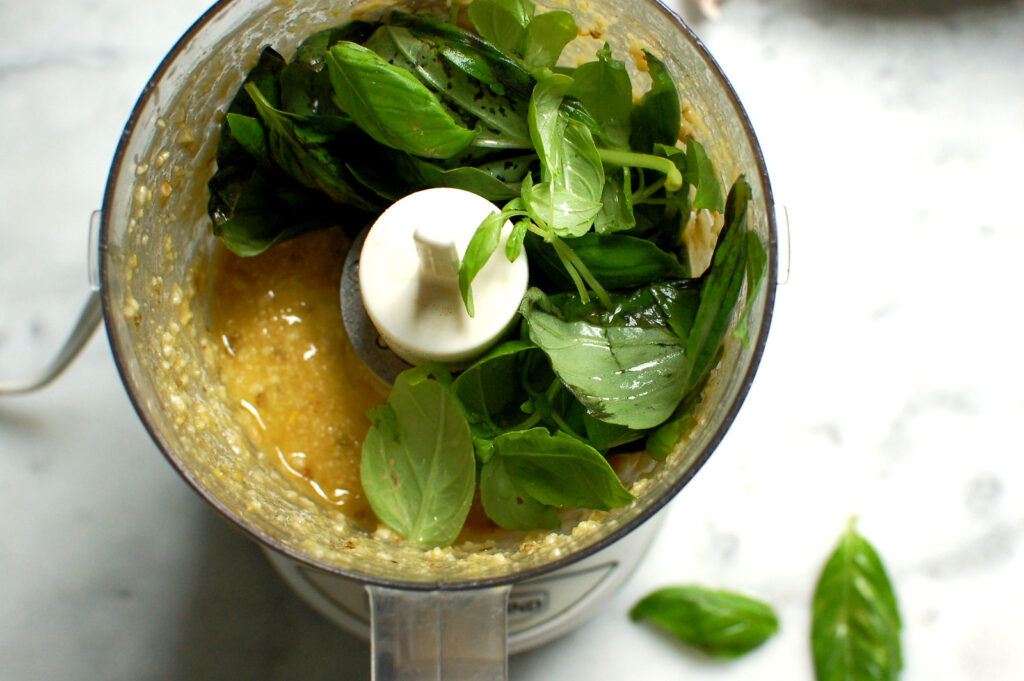
Step 3: Blend the basil, pine nuts, garlic, and oil. Then, add the wet basil straight from its soak. Blend until smooth and creamy, adding a bit of water as needed to loosen.
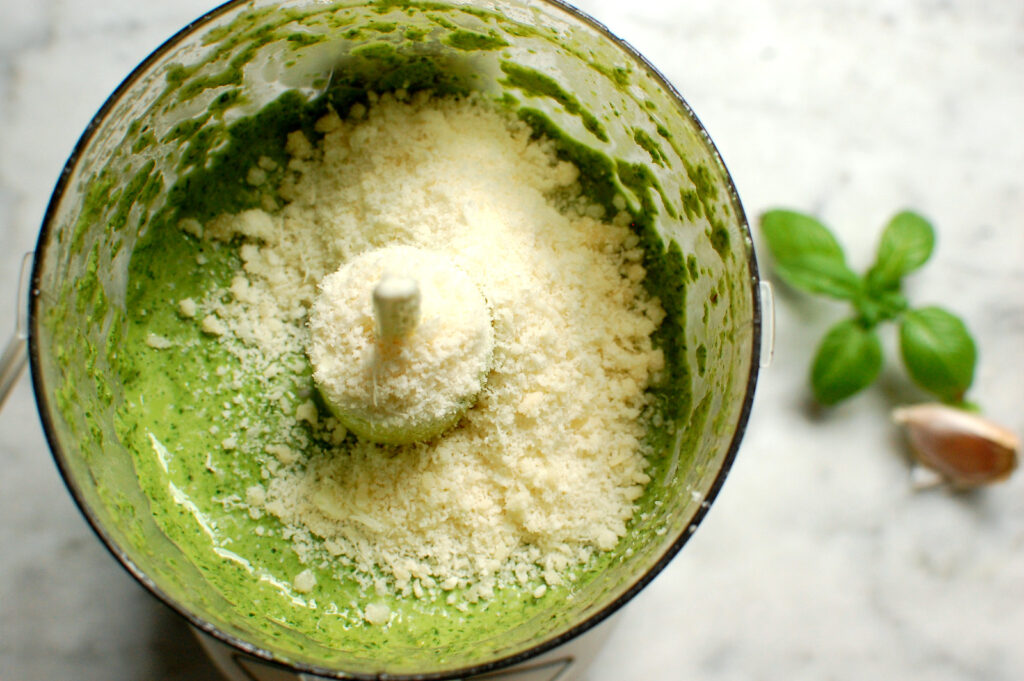
Step 4: Add the cheeses last. Add the grated Parmigiano and Pecorino cheeses, and blend until incorporated.
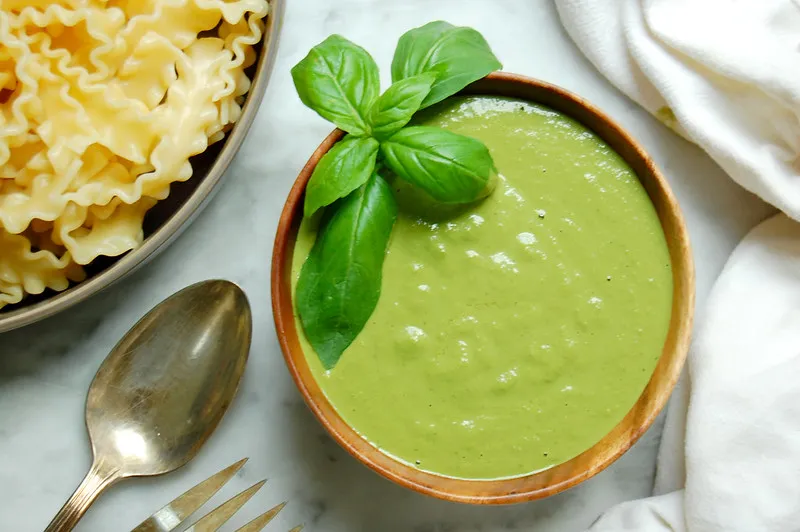
Step 5: Use or store immediately. Toss with pasta right away, or transfer to a container, cover the surface with a thin layer of olive oil to prevent oxidization, and refrigerate.
A note on yield: This recipe makes about 1¼ cups. If you halve it, the quantity may be too small for a full-size blender jar to handle; use a personal blender cup instead.
Equipment Note: Blender or Food Processor? Or Neither!
Both a blender or small food processor work, though chef Laboa prefers a blender over a food processor. A high-speed blender like a Vitamix (the gold standard) makes the silkiest version, closest to what Chef Laboa serves, but a regular blender is fine. A food processor produces a slightly coarser, more rustic pesto, which is also good (though not recommended by the chef); it’s just a different texture and you may need to blend it for a little more time.
The most common issue with blenders or food processors is ingredients that won’t blend. This is more likely to happen when you add the basil. This means there isn’t enough liquid to get things moving, or it is packed too tightly. Try adding the basil in two additions, or use the basil-soak water, added a teaspoon at a time until the mixture turns over.
Want to kick it old-world style? Traditional pesto Genovese is made by hand in a mortar and pestle — the championship requires it. If you own one and have the patience, go for it!
Ingredient Substitutions
If you can source all of the ingredients, perfect. It won as written. But here’s what to do if you want or need to make substitutions.
- Pecorino Sardo or Pecorino-Toscano: Use Pecorino-Romano (Locatelli). Romano is a bit saltier and sharper, though, so cut the added salt by 1/4 teaspoon.
- Italian pine nuts: Use supermarket pine nuts. They are slightly less buttery, but still work just fine.
- Ligurian olive oil: Substitute any mild extra-virgin olive oil.
- Parmigiano-Reggiano: Ok, this is the one ingredient I would argue should not be substituted because nothing else has its depth and flavor, but if you can’t find it, just use the best parmesan you can find.
- Pine nuts: blanched, skinless raw almonds are the closest substitute. I use raw pumpkin seeds if I need to go nut free.
- Adding lemon juice: Plenty of modern recipes use lemon juice to brighten the flavor. Traditional basil pesto Genovese does not use lemon, though, and neither does this one. If you must, add a teaspoon.
How to Serve Basil Pesto
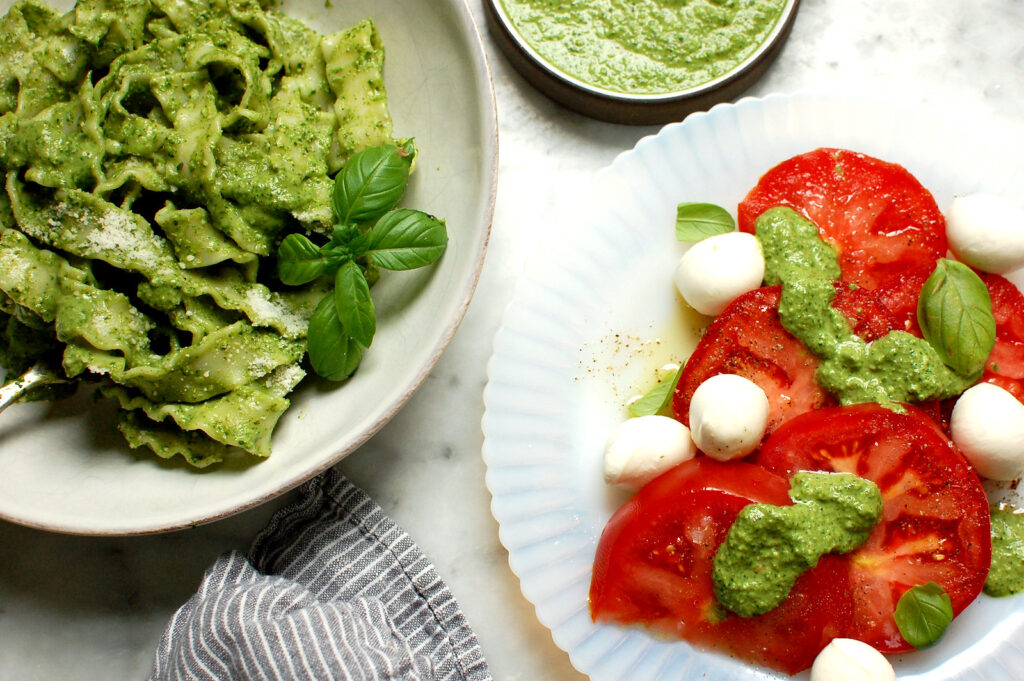
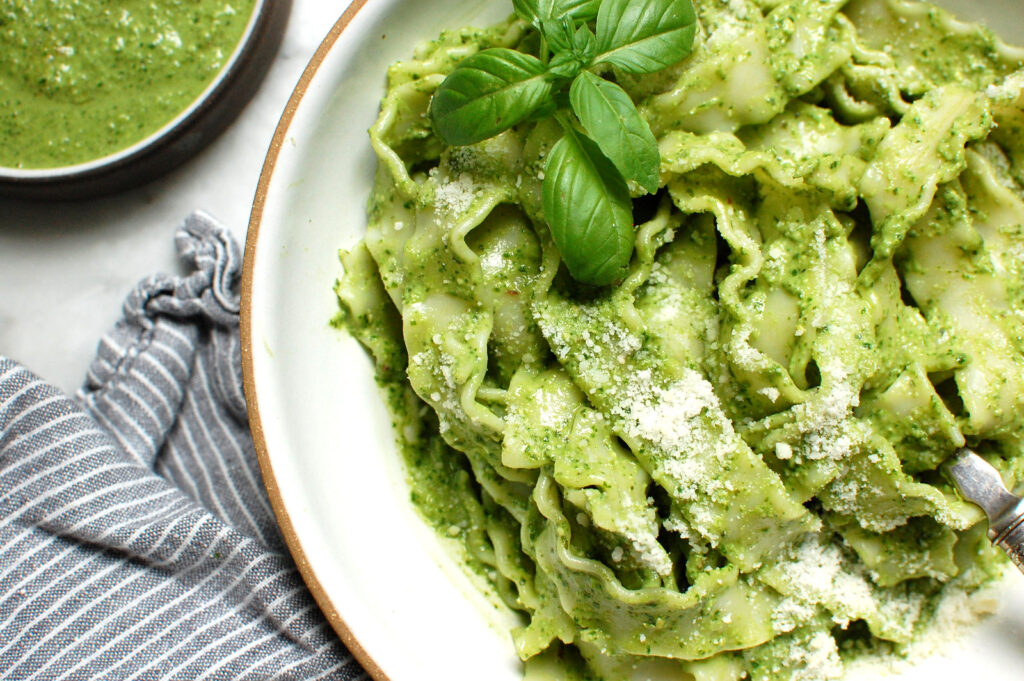
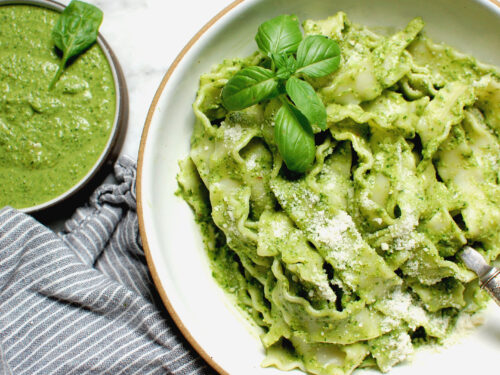
The classic way to serve basil pesto is as a sauce for pasta. Many pasta shapes work well. I like to toss my pesto with linguine, trofie (the traditional Ligurian shape), or pappardelle. You will use about 1 cup of pesto per pound of pasta. Before draining, reserve a cup of the pasta cooking water and add it a tablespoon at a time, as needed, as you toss to make sure the pasta is saucy and does not get dry. You can also add cooked green beans or cooked chunks of potatoes to the pasta, which is also traditional.
One rule above all: don’t cook the pesto. Heat dulls the color and flattens the flavor. Toss the pesto with hot pasta off the heat. It will warm through on its own.
Beyond pasta, this Genovese pesto can also be used a lot of other ways:
- Spread on bread
- Spooned over grilled or roasted chicken just before serving
- As a pizza base under mozzarella and sliced tomatoes
- Stirred into scrambled eggs or a summer frittata
- Tossed with warm white beans and a drizzle of olive oil
- As a dip for crudité or a torn baguette
- Dollop onto a tomato and mozzarella caprese salad
How to Store Basil Pesto and How Long It Lasts
In the Refrigerator
Transfer the pesto to an airtight container. Smooth it out and pour a thin layer of olive oil over the surface — just enough to seal it from the air — before closing the lid. The oil barrier will keep the top from oxidizing and turning brown. Stored this way, pesto keeps for up to three days, staying green and fresh. If the surface does darken slightly, it still tastes fine. Either stir it in, or scrape off the top layer.
Note: Basil leaves, by the way, hate the refrigerator and will turn brown. Keep the stems in a jar of water on the counter, like flowers. See my full instructions in my guide to storing fresh herbs and How to Chiffonade Basil.
In the Freezer
Pesto freezes beautifully for up to three months in an airtight container. To thaw: put the pesto at room temperature for an hour or two, or overnight in the fridge. Avoid the microwave and the stovetop. Heat will cause the pesto to separate and the cheeses to congeal. (I know from experience. Trust me.)
Buon appetito!
More Italian Recipes to Try:
The Best Basil Pesto Recipe (Pesto Genovese)
Essential Equipment
- Blender a high-speed blender makes the silkiest pesto; use a small food processor if that's your only option, but the texture will be coarser.
- Large bowl for soaking the basil in ice water
- Microplane zester for grating the cheeses
Ingredients
- 6 cups loosely-packed Genovese basil, preferably young, bright-green leaves
- 1/3 cup pine nuts, preferably Italian
- 1/3 of a medium, fresh garlic clove
- 1/2 cup fruity, mild extra-virgin olive oil, preferably from Liguria
- 1 teaspoon medium or coarse flaky sea salt, such as Maldon or fleur de sel (use less if using saltier pecorino-Romano cheese or Morton's or table salt)
- 1/3 cup freshly-grated pecorino Sardo or pecorino-Toscano cheese (pecorino-Romano is an ok substitute)
- 1/3 cup freshly-grated Parmigiano-Reggiano cheese
Instructions
- Chill the blender bowl: Place it in the freezer, or fill it with ice and cold water and let it stand while the basil soaks. Empty just before blending.
- Meanwhile, rinse the basil, then soak the leaves fully submerged in a large bowl of cold ice water for 10 to 15 minutes. Reserve a few tablespoons of the soaking water before draining.
- Combine the pine nuts, garlic, and olive oil in the chilled blender. Blend until the nuts are very finely chopped and the mixture is creamy. Add the salt and pulse briefly to combine.
- Working in several handfuls, lift the basil from the bowl of water. Shake some of the excess water off, but not all, and add it to the blender. Pulse in the blender until it is a smooth, beautiful green color. If necessary, add more water a teaspoon at a time until it blends and emulsifies fully.
- Add the two cheeses and blend again until fully incorporated. Taste for seasoning. Serve immediately, or store (see Notes).
Notes
Nutrition
Disclaimer: Nutrition information is provided for courtesy purposes only, and is an estimate not verified by medical or nutrition experts. Read the full nutrition disclaimer.





28 comments
BerhG
I have a question– does the recipe mean blender or food processor? I started out with a chilled glass blender but it does not have a pulse option and the basil would not blend, so switched to my Cuisinart. The mix was also very salty but maybe my flaked salt was not the right kind. I had to add more garlic, basil and nuts to help that issue.
The bright green is great though and I will use this technique. Just wondering about the blender vs. food processor and if others found this too salty and not quite garlicy enough?
Thanks.
Unpeeled
Hi, Beth! Great questions and thanks for writing. You can use either a blender or a food processor, though a blender will get the pesto a little smoother. If you don’t have a pulse setting, you can just turn the blender on and off in stages manually, and add a little water as necessary to loosen the leaves so they blend. As for the salt and garlic, Chef Laboa only uses a tiny amount of garlic to let the basil flavor come through, though you are right to adapt it to your own taste. As for salt, Pecorino-Toscano is less salty than Pecorino-Romano, so if you sub Romano, you should cut back slightly on the salt. I mentioned this is the text of the article, but will add it to the recipe as well. And different salts vary in salinity depending on type and brand, so it can indeed be a bit of a “choose your own journey.” But sounds like you did a wonderful job tweaking it! Thanks for writing.
Gina
I encountered challenges to the recipe, as well. The recipewas so small and I didn’t have enough ingredients to double it, that it didn’t even blend well in my blender nor my magic bullet nor my Cuisinart..
Unpeeled
Argh…so sorry to hear this! The recipe calls for 6 cups of loosely-packed basil, which is admittedly a measurement subject to variation. It sounds like maybe you needed some more basil, since the pesto should be enough for a full pound of pasta, maybe with even a little leftover. And if you make it again, just add basil water, a tablespoon at a time, until the mixture is loose enough to blend. If there’s not enough liquid, it won’t process/blend very well.
Raquelle
Outstanding. Blanching the basil leaves is a game changer!!!
Bonnie B.
Silky and fabulous. I honestly wasn’t expecting it to be this good but it really is. Good techniques here, too.
Charlotte
This is better than anything I’ve tasted anywhere!!!! Fantastic and sooo easy Love it !
Thankyou
Charlotte
Amy
Made this tonight and it was fantastic! Followed the recipe and used the same pasta as pictured. An easy wonderful dinner !!
Thankyou
dr.sarah
When this recipe posted I rushed out and made it that day because I have so much basil in my garden right now. I did not use the big leaves, which seemed wasteful at first, but I do think that there is a difference. I used authentic Locatelli cheese and parmigiano-reggiano as described. This was so wonderful. I also added a little water to make it blend smoothly.
Francesca P.
10 stars! Wow. And I have had a lot of pesto. Thanks for this recipe.
Emily D.
Perfection. I did need to add some water to get it to emulsify, maybe a tablespoon or so? This gets my award, too 🙂 I love, love, LOVE this and it is truly the best I have ever had. I love that it is so smooth.
M.P.
Fabulous!!!!!!!! I will use this recipe from now on. It is so simple. Agree that ingredients are key.
Helen Bond
Oh. My. God. This is THE best pesto I have ever had and I see why this won. I used a good olive oil but did not use Italian pine nuts, just the regular grocery store variety, and it was absolutely amazing.