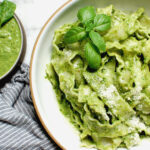
The Best Basil Pesto Recipe (Pesto Genovese)
The basil pesto recipe that won the World Pesto Championship in Genoa, Italy, and is adapted from Italian chef Paolo Laboa. One cold-water technique keeps it silky, vivid green, and never bitter. This recipe makes about 1 1/4 cups, enough for one pound of pasta, with a little left over. This freezes well, and can also be spooned over caprese or spread on crusty bread.
Servings: 10 2 tablespoons p/serving (about 1 1/4 c. total)
Calories: 155kcal
Essential Equipment
- Blender a high-speed blender makes the silkiest pesto; use a small food processor if that's your only option, but the texture will be coarser.
- Large bowl for soaking the basil in ice water
- Microplane zester for grating the cheeses
Ingredients
- 6 cups loosely-packed Genovese basil, preferably young, bright-green leaves
- 1/3 cup pine nuts, preferably Italian
- 1/3 of a medium, fresh garlic clove
- 1/2 cup fruity, mild extra-virgin olive oil, preferably from Liguria
- 1 teaspoon medium or coarse flaky sea salt, such as Maldon or fleur de sel (use less if using saltier pecorino-Romano cheese or Morton's or table salt)
- 1/3 cup freshly-grated pecorino Sardo or pecorino-Toscano cheese (pecorino-Romano is an ok substitute)
- 1/3 cup freshly-grated Parmigiano-Reggiano cheese
Instructions
- Chill the blender bowl: Place it in the freezer, or fill it with ice and cold water and let it stand while the basil soaks. Empty just before blending.
- Meanwhile, rinse the basil, then soak the leaves fully submerged in a large bowl of cold ice water for 10 to 15 minutes. Reserve a few tablespoons of the soaking water before draining.
- Combine the pine nuts, garlic, and olive oil in the chilled blender. Blend until the nuts are very finely chopped and the mixture is creamy. Add the salt and pulse briefly to combine.
- Working in several handfuls, lift the basil from the bowl of water. Shake some of the excess water off, but not all, and add it to the blender. Pulse in the blender until it is a smooth, beautiful green color. If necessary, add more water a teaspoon at a time until it blends and emulsifies fully.
- Add the two cheeses and blend again until fully incorporated. Taste for seasoning. Serve immediately, or store (see Notes).
Notes
A few tips before you start: The garlic quantity really is that little — a sliver. Raw garlic has a lot of bite, and the point here is that the basil is the highlight. If the pesto won't blend, it needs liquid: add the reserved basil-soak water a teaspoon at a time until it turns over. You may need to help it along with a spatula. You may also want to go a bit easier on the salt if you're also salting your pasta water well.
How to serve: Pesto pasta is the classic choice. If you're making pesto pasta: Use ¾ cup to 1 cup pesto per pound, tossed off the heat, loosened with a spoonful of pasta water if needed.
Beyond pasta, spoon this over grilled or roasted chicken, spread it on bread or as a pizza base under mozzarella and tomatoes. Stir it into scrambled eggs, or dollop it onto a tomato and mozzarella caprese.
To store: Refrigerate your pesto in an airtight container for up to 3 days, with a thin layer of olive oil over the surface to keep the top from oxidizing and turning brown. This freezes well for up to three months; thaw at room temperature for about an hour, or overnight in the fridge. Avoid reheating in the microwave or on stove, which will separates the sauce and "cook" the cheeses and basil.
Nutrition
Calories: 155kcal | Carbohydrates: 1g | Protein: 3g | Fat: 16g | Saturated Fat: 3g | Polyunsaturated Fat: 3g | Monounsaturated Fat: 9g | Cholesterol: 5mg | Sodium: 340mg | Potassium: 76mg | Fiber: 0.4g | Sugar: 0.3g | Vitamin A: 813IU | Vitamin C: 3mg | Calcium: 106mg | Iron: 1mg
Disclaimer: Nutrition information is provided for courtesy purposes only, and is an estimate not verified by medical or nutrition experts. Read the full nutrition disclaimer.
