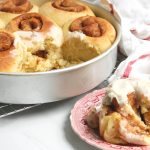
The Best Homemade Cinnamon Rolls
This homemade cinnamon roll recipe makes a batch of fluffy, soft buns, rich with cinnamon sugar and topped with gooey icing. With step-by-step instructions, I also share pro tips, plus how to make the rolls in advance, store them, and more. Because of the careful steps in making the dough, rolling, cutting, and baking, I included a ton of helpful photos in the full post. Scroll through for visual aid!
Servings: 8 or so cinnamon rolls
Calories: 489kcal
Ingredients
For the Dough
- 1 package (1/4 oz.) active dry yeast
- 1/4 cup lukewarm water (100 - 105°F)
- 2/3 cup lukewarm milk
- 1/3 cup sugar
- 1 teaspoon kosher salt
- 2 eggs, at room temperature
- 5 tablespoons very soft butter
- 3 1/4 cups all-purpose flour, plus more for dusting
For the Filling
- 5 tablespoons very soft butter
- 2/3 cup packed light-brown sugar
- 1 tablespoon ground cinnamon
For the Icing
- 3 cups confectioner's sugar
- 3 tablespoons melted butter
- 3 tablespoons hot milk, plus more as needed
- 2 teaspoons pure vanilla extract
Instructions
For the Dough
- In the bowl of a stand mixer fitted with the dough hook attachment, or in a large mixing bowl, dissolve the yeast in the warm water for about 2 minutes. (Give it a quick whisk in the water so it mixes in.)
- Add the milk, sugar, salt, eggs, butter, and 2 cups of the flour. Use a spatula or wooden spoon to mix the ingredients until fully combined and smooth. Add the final 1 1/4 cups flour and mix until the dough forms a shaggy mass. Switch to the dough hook and knead on medium-low/medium for about 10 minutes. The dough should form a smooth ball and stretch when you pinch some away from the dough ball. Kneading by hand? Do so on a lightly-floured countertop. Good job on the arm and hand workout!
- Gently transfer the dough into a lightly-greased bowl. Cover with plastic wrap or a clean, damp kitchen towel and let rise in a warm place until doubled in bulk, about 1 1/2 to 2 hours. PRO TIP: In addition to the size, you will know the dough is ready when it holds a nice, lazy dent when you press into it with your finger. I strongly recommend using a bowl scraper to turn the dough out onto the countertop so it holds its shape and doesn't tear or pull. PRO TIP: It's important to cover dough when it's rising. Otherwise, the dough will form a dry skin on top. (And no one likes dry skin.) Dough likes to rise at a warm temperature, between 75 and 80 degrees Fahrenheit. If that's not possible and your house is chillier than that, just put it in a cozy spot in your house, and give it a little extra time to double in bulk. It will get there.
For the Filling
- While the dough is rising, combine the softened butter, brown sugar, and cinnamon and stir until well mixed. Set aside.
To Assemble, Bake, and Finish
- Turn the risen rough onto a clean, lightly-floured work surface. Lightly dust the dough with flour, and press it into a rough rectangle with your fingers. Use a rolling pin to roll the dough into a 16" wide x 10" high rectangle, or thereabouts. The dough should be 1/4" thick.PRO TIP: I use a bench scraper to push the dough into shape around the edges as I roll, and always keep a clean 12" ruler in my kitchen utensil drawer for just such an occasion. Check the bottom of the dough as you roll to make sure it's not sticking. Dust with a little more flour as needed.
- Use an offset spatula to spread the cinnamon-sugar mixture over the surface of the rolled dough, leaving a small 1/2" margin around the edges, like a picture frame. Working from the bottom edge of the dough closest to you, begin to roll the dough upward until it spirals its way to the top edge. Pinch the seam closed with your fingers.PRO TIP: A common mistake is a cinnamon bun that unravels when baked, making an open spiral instead of a tight swirl. This mistake occurs when the roll is not rolled tightly enough or closed at the seam. To roll the cinnamon roll correctly for the best result, pull the dough back slightly, as though it were a little elastic, before folding it over as you roll. This creates a tighter roll.
- Use a knife or bench scraper to trim the left and right edges of the cinnamon roll log. Discard. Cut the log into 8 even pieces, then place them spiral-side up in a greased casserole or cake pan. There should be space between each individual bun to allow the dough to expand. Cover and let rest at room temperature for about 30-45 minutes, until they rise a bit (they won't double in size, just get a little puffy). You can use the following size pans: 10" round cake pan, 9" square pan, or an 11 x 7" rectangular casserole. Make sure the sides are at least 2" high.
- Preheat the oven to 350°F. Remove the covering from the cinnamon buns, and bake for 25 minutes, until light golden brown and dry looking in the seams between the buns.
- While the cinnamon rolls are baking, whisk the confectioner's sugar, melted butter, hot milk, and vanilla together until if forms a thick but smooth, spreadable icing. If it's too thick like spackle, add more hot milk as needed, a tablespoon at a time.
- Remove the baked cinnamon rolls from the oven. Let them cool on a wire cooling rack for about 10 minutes. Spread the icing all over the top (you may not use it all), and serve warm.
Notes
Making cinnamon rolls in advance:
One way to make homemade cinnamon rolls in advance is to follow them all the way through to baked, then freeze them when cool, covered and still in the baking pan. Then just plop the whole thing back in a warm oven (uncovered) until heated through, and spread with the frosting to serve. The other way to make them in advance is to follow through step 7 above, but after placing the rolls face-up in the greased baking dish, cover and refrigerate overnight instead of letting them rise again. (The buns should only rise in the fridge a very small bit, if at all.) Bake the next morning: Remove the rolls from the fridge, let them rise on the countertop until fluffy (about 30-45 minutes), then bake and frost with the powdered sugar icing.Storing cinnamon buns:
Like any fresh bread, cinnamon buns are best the day they are baked, but this will stay good for about two days covered at room temperature. The best technique, though, is to freeze them immediately once cooled and reheat when you want them.Nutrition
Calories: 489kcal | Carbohydrates: 115g | Protein: 8g | Fat: 21g | Saturated Fat: 13g | Polyunsaturated Fat: 1g | Monounsaturated Fat: 5g | Trans Fat: 1g | Cholesterol: 93mg | Sodium: 470mg | Potassium: 153mg | Fiber: 2g | Sugar: 28g | Vitamin A: 673IU | Vitamin C: 0.04mg | Calcium: 77mg | Iron: 3mg
Disclaimer: Nutrition information is provided for courtesy purposes only, and is an estimate not verified by medical or nutrition experts. Read the full nutrition disclaimer.
